
(The article is orginially published in the book, Margins of Margins of Voices: Towards an Inclusive Disability Discourse, edited by Zinia Mitra and Santosh Mahaldar, published by Cambridge Scholars Publishing, UK.)
Abstract
Discourses on the disability studies have sic passim stemmed from outlandishly positing the prime importance to the physique of a person (or of an animal, if spoken from broader perspectives). Thus, the skeletal structure of this discourse is brooded in a physical domain of concern, disposing all tutelage of theosophical nurturing. In this paper, I intend to turn the table upside down. After exploring the acceptance of the disabled in the literature of the Sanātana Dharma, it attempts to analyze the aspects of disability from the purview of the ātmā, and not the body. Primarily focusing on the Bhāgavd Gītā and the Upaniṣads, it demonstrates how physical disability cannot be a boundary in the theosophical realm. As the paper contains multiple ślokas, mantras, and Sanskrit terms, they will either be written in toto with translation or they will be transliterated in accordance with the International Alphabet for Sanskrit Transliteration (IAST).
Keywords: Disability/disabled; Sanātana Dharma; ātmā; paramātmā.
Introduction
In order to pave the way for a trailblazing dimension in any field of research, it is imperative that the existing literature must be studied and mentioned ab initio for general awareness of the readers. Therefore, a brief introspection on how various ancient occidental cultures, religions, and civilizations have opined about the disabled becomes inevitable. In the Greek mythology, disability has mostly been considered to be a curse, a sign of inferiority, and an act of god’s wrath. However, Dr. Robert Garland, Professor Emeritus of Classics at Colgate University, remarks:
It seems that there was no special sympathy for any disabled Greek person from their society. But say if one is blind, they would be told they were gifted with clairvoyance, just like the blind seer Tiresias, or were gifted with a poetic song as with Homer.
People with other forms of disability apart from blindness, especially those who were disabled since birth, were looked down upon. The Spartans used to abandon the impaired newborns to the jungles to be eaten by the beasts so that they do not incur the wrath of the gods. The ancient Romans were also extremely hostile towards the ‘unnatural’ children. In 449 BCE, the Roman senate promulgated the Laws of the Twelve Tables which contain the legislation to “kill the deformed child quickly”. In fact, Aristotle had also recommended a law that prevented the upbringing of deformed children.
The Abrahamic religious texts too seem little less cordial to the disabled, mostly considering disability as an act of god and implying that it is the punishment of some sins. Pauline A. Otieno in an article on the Disability Studies Quarterly remarks: “Disability is attributed to God. The general view of the Old Testament writers is that God brings disability as punishment for transgressions for sin or as an expression of God’s wrath for people’s disobedience”. According to Christianity, Jesus Christ bore the ‘Burden of Sins’ to save mankind from god’s intended destruction of the species. The biblical literature narrates how Christ cured several people from their illness, misery, and disability. However, the Bible (John 9:1-7) describes one encounter between Jesus Christ and a blind man in which the disciples ask Jesus Christ the cause of the man’s blindness. He replies them that it is neither because of the sins committed by that man, nor by his parents, rather it is purely an act of god so that his mercy can also be shown. Then, he cures the man by anointing a muddy poultice made with his own saliva. This act is considered to be a miracle and Christ is projected as the next messiah. Curing the sufferers appears as an act of miracle multiple times. For instance:
And great crowds came to him, bringing with them the lame, the blind, the crippled, the mute, and many others, and they put them at his feet, and he healed them, so that the crowd wondered, when they saw the mute speaking, the crippled healthy, the lame walking, and the blind seeing. And they glorified the God of Israel. (Matthew 15:30-31)
Although they do not openly advocate any antipathy towards the disabled and, rather, shows mercy and pity, if the dormant connotation is critically examined, it appears that disability is often regarded as a crisis. Instilling pride in the identity of the disabled is something that is conspicuously missing in this context. The Qur’an seems to suggest two primary attitudes towards the disabled, according to Hiam Al-Aoufi, Nawaf Al-Zyoud, and Norbayah Shahminan. First, observing the principle of ‘qadar’ stated in the Qur’an (9.15) which suggests the concept of preordination (i.e. that which is meant to be, will be, and what is not meant to be, can never occur), some Islamic scholars believe that disability is an act of god and a part of an individual’s ‘qadar’. Secondly, on the other hand, some Islamic scholars tend to support the concept of ‘reward and punishment’ which implies that one’s disability is that individual’s bane.
However, the literature and theosophy of the Sanātana Dharma have meta-narratives and multi-alignments while discussing about disability. Not only one finds a general acceptance of the disabled in the society, but sometimes they are even highly celebrated figures. Thus, the discourse on disability, if envisaged from the kaleidoscope of the Sanskrit literature, takes a new dimension altogether. The upcoming sections would justify the aforementioned claim in three segments.
Accepting Disability and the Disabled
One of the most revered sages in the literature of the Sanātana Dharma, Aṣṭāvakra, was a person with eight forms of deformity, just as the name suggests in Sanskrit (i.e. ‘aṣṭa’ meaning eight, ‘vakra’ meaning deformity).
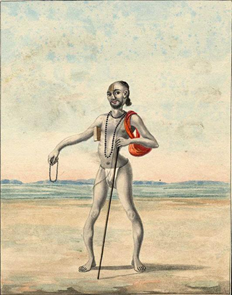
[A 19th century CE painting of Aṣṭāvakra by an anonymous artist, preserved at British Museum, Reg. no. 1880-0.2073]
The legend of Aṣṭāvakra, which is chiefly found in the Mahābhārata (3.132-134), states that Aṣṭāvakra was a supernaturally precocious child. As per the legend, one day when his father, Kahoḍa, was reciting the mantras of the Veda, he erred several times. Observing this, Aṣṭāvakra spoke from his mother’s womb, instructing his father on correct intonations. Infuriated by the audacity, Kahoḍa cursed his own son to be born as a deformed child. Aṣṭāvakra was born in the absence of his father who had left to seek wealth at the court of king Janaka by participating in a contest of intellectual debate. However, Kahoḍa was defeated there and, as per the custom of the contest, he was incarcerated. Later, when Aṣṭāvakra was ten years old, he came to know about his father’s fate and decided to free him by taking part in the contest himself. The very next day, he went to the court of Janaka, but he was not allowed to enter by the guards. However, while conversing with him, the guards realized that though the child is only of ten years, he had the eloquence and wisdom of a qualified brāhmaṇa. So, Aṣṭāvakra was let in and he directly confronted Janaka, asking the king to arrange a verbal duel between him and Vandī, the most intellectual rhetor of the court. The king, at first, tested Aṣṭāvakra with three cryptic puzzles. Solving these, Aṣṭāvakra earned his right to compete against Vandī in a battle of eloquence in which he easily emerged victorious. Mesmerized by the wisdom of Aṣṭāvakra, king Janaka appointed him as the chief advisor in his court and freed his father immediately. Pleased with the endeavour of his son and realizing his own mistake, Kahoḍa took the curse back and Aṣṭāvakra was cured. The legend also gets mentioned in the form of a simile in the Rāmāyaṇa (6.119.17) when Daśaratha comes down to earth from heaven to bless his son, Rāma, after he defeated Rāvaṇa.
Although this legend initially depicts disability as a result of a curse, it also inadvertently sets a narrative that a person with disability is neither discriminated, nor abhorred in the Sanātana culture. Striving assiduously, any man could reach the acme of success. Even today, Aṣṭāvakra is remembered with veneration because of his seminal work on theosophy known as the Aṣṭāvakra Gītā (or the Aṣṭāvakra Saṃhitā).
Another instance of filial piety can be traced in the anecdote of Śravaṇa Kumāra in the Rāmāyaṇa (2.63-64). Śravaṇa Kumāra was a young brāhmaṇa whose parents, Śāntanu and Jñānavatī, were blind.
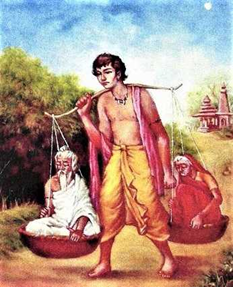
[A 19th century CE painting of Śravana Kumāra (carrying his blind parents) by Rājā Ravi Varmā (1848-1906), preserved at Raja Ravi Varma Heritage Foundation, Bengaluru, India]
Śravaṇa Kumāra wanted to take his parents to the four sacred pilgrimages. Unable to afford a vehicle owing to poverty, he carried them on his shoulder. Once, while he was passing through the forest, his parents felt thirsty and sent him to fetch some water. Meanwhile, king Daśaratha, father of Rāma, was out for mṛgayā (deer hunting). Hearing some sound coming from the bushes, Daśaratha hurled his arrow which undesirably pierced the heart of Śravaṇa Kumāra. Just before his demise, Śravaṇa requested Daśaratha to inform his parents and take care of them. However, when Daśaratha brought the sad news, Śravaṇa’s parents died of grief, cursing the king to die of putraśoka (grief for the separation with the son). The curse actually proved to be true as Daśaratha departed while Rāma was in exile. Thus, an interesting aspect that cannot be missed here is that whereas previous accounts have counted disability as a curse, here the disabled have cursed an able-bodied king.
It is to be noted that Daśaratha wanted to coronate his eldest son Rāma as the next heir to his throne, however his plan was nipped in the bud by his second queen, Kaikeyī, under the influence of a dāsī (slave woman) named Mantharā. The name Mantharā means ‘a woman with a hunchback’ and the character is a disabled person.
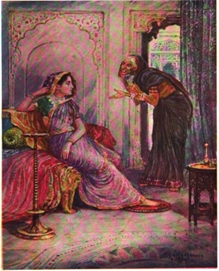
[A 19th century CE painting of Kaikeyī and Mantharā by Mahādeva Viśvanātha Dhurandhara (1867-1944), collected from The Modern Review, August, 1909.]
Although Mantharā was a slave to Kaikeyī, she was a mother-figure to her. Here, it can be noted that a person with disability was not only accepted, but was also provided a status which could influence the queen, despite being a mere slave. Observing that Kaikeyī’s stepson Rāma was to be the king and not her biological son, Mantharā advised Kaikeyī to compel Daśaratha to crown her son, Bhārata, as the next king by retrieving two pending boons that she was promised by her husband when she saved him from a fatal wound in a battle. Heeding to the ill advice, Kaikeyī asked Daśaratha to send Rāma to exile and to crown Bhārata. Staying true to his promise, Daśaratha had to comply despite of his severe remonstrance. However, Bharata was highly infuriated by this and insulted Mantharā for her felonious advice. The character of Mantharā is mostly regarded as a vile one. Here it is to be noted that just like one finds a smorgasbord of attributes and characteristics among the able-bodied people, so can be found in the disabled folks as well.
A villain with disability can again be found in the character of Śakuni in the Mahābhārata. Śakuni, the elder brother of Gāndhārī and the maternal uncle of Duryadhana, had a limp. He was also the prince of the Gāndhāra region. Though he was partially disabled, he enjoyed a great deal of status in the society and in the court of the king. He is characterized as a shrewd and unscrupulous man who had tremendous influence on his nephew. It was he who, cheating at the game of dice, sent the Pāṇḍava clan to exile.
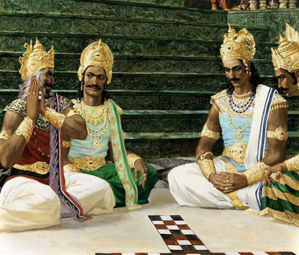
[A 21st century CE painting of Śakuni (playing dice) by an Italian artist named Giampaolo Tomassetti (1955-), collected from his Mahabharata: Indian Art Series (2015).]
Whereas Śakuni is often projected as a villain, it is not so with his brother-in-law, Dhṛtarāṣtra, who was blind since birth. Dhṛtarāṣtra is a figure that is neither black, nor white, but rather gray. Although he knew about the nefarious intentions of his sons ab initio, especially of his eldest child Duryadhana, he did not take any strict action to amend them. He was so fond of his sons that he overlooked all their treacheries and fallacies. However, if one observes the character of Dhṛtarāṣtra closely, he was neither vitriolic to the Pāṇḍava clan, nor did he want to deceive them. Thus, Dhṛtarāṣtra was not merely blinded by sight, but also by his love for his sons. Can this blind love also be called as an intellectual disability?
Dhṛtarāṣtra’s father, Vicitravīrya, had two wives but he was impotent and died without providing an heir to the throne. In order to further the kingship of the family, Vicitravīrya’s mother, Satyavatī, invited her love child, Vyāsadeva, to impregnate both the queens with their consent. However, Vyāsadeva was not a very handsome man and both the queens could not enjoy the coitus. The first queen, Ambikā, had closed her eyes during the act, whereas the second, Ambālikā, turned pale. Enraged at this disrespect, Vyāsadeva cursed that Ambikā’s child would be blind, whereas Ambālikā would have a feebly pale child. Dhṛtarāṣtra was born to Ambikā, proving the curse to be true. Thus, Dhṛtarāṣtra’s blindness was owing to a curse by his own biological father. However, his wife, Gāndhārī, is certainly a rarest example of disability. Although she was born as a beautiful able-bodied princess, she decided to blindfold herself for the rest of her life when she came to know that her about-to-be husband was blind by birth. There, perhaps, is no case in history where we come across an instance where an able-bodied princess has not only accepted a blind husband, but also the blindness itself. Owing to this great sacrifice, she is often hailed as an epitome of a supportive wife.
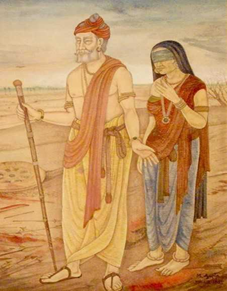
[A 20th century CE painting of Dhṛtarāṣtra and Gāndhārī by Maṇīndra Bhūṣaṇ Gupta (1898-1968), collected from Tumblr ID: @arjuna-vallabha]
However, it is ironic to observe that her brother Śakuni, who was partially disabled, did not approve of her marriage to a blind prince. Śakuni held the opinion that a blind man, who cannot look after himself properly, can never look after the whole kingdom. Although Gāndhārī did not pay much heed to her brother’s cynicism, a critical reader must not miss that the abomination towards one disabled person by another is a very peculiar instance. Rather than having sympathy, these two disabled folks never liked each other very much.
Now, that we have discussed about the human characters with disability, let us focus on the non-humans, supernatural, and godly characters as well. In the literature of the Sanātana Dharma, Viṣṇu has ten avatāras (incarnation on earth). Vāmana, the fifth avatāra of Viṣṇu, is a three-legged dwarf. Dwarfism is regarded as a form of deformity and a partial disability.
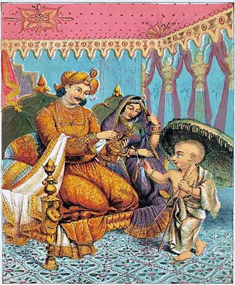
[A 19th century CE painting of Vāmana Avatāra by an anonymous artist, preserved at Calcutta Art Studio (Kolkata, India).]
A detailed account of Vāmana is to be found in the Bhāgavata Purāṇa (8.15.1-8.23.31). According to the text, once upon a time, Bali, the king of the dānavas (equivalent to demons or devils in Sanskrit), conquered all the three realms (viz. the svarga or heaven, the marta or earth, and the pātāla or netherland) by defeating Indra, the king of the devatās (deities). Disheartened, the devatās asked Viṣṇu to fight for them, but he refused as Bali was his devoted bhakta (worshipper). However, he assured them that he would intervene in the matter and secure the devatās their rightful place. Meanwhile, Śukrācārya, the guru of the dānavas, asked Bali to perform an aśvamedha yajña (great ceremony of sacrifice) as was the custom for any new ruler of the three realms. While the yajña was going on, Viṣṇu took his fifth avatāra and appeared as a three-legged dwarf brāhmaṇa named Vāmana. It was the custom in the yajña that if someone sought anything from the performer, he would have to donate that without fail. Vāmana went to Bali and asked for a proportion of land that could hold his three strides. Bali, without understanding Vāmana’s plan, accepted. To make the sanction of the land official, Bali had to pour water from his kamaṇḍalu. As he was about to do it, Śukrācārya recognized Vāmana’s real identity and warned Bali. But, Bali continued in his action, unheeded. In order to stop the water from his kamaṇḍalu, Śukrācārya took the form of a bee and entered its hole. However, Vāmana was clever and poked a blade of grass into the spout. This pierced an eye of the bee and it came out of the kamaṇḍalu in pain. When Śukrācārya appeared in his human form again, he found out that he has lost his left eye. Thus, Śukrācārya can be taken as an example of a transition from, in the words of disability studies scholars, a ‘temporarily able-bodied’ (TAB) to a partially disabled one.
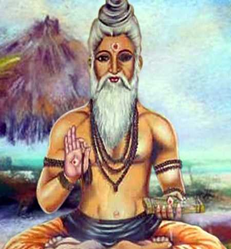
[An undated painting of the Śukrācārya (blinded by left eye) by an anonymous artist, collected from an article by Abhilash Rajendran, published by the Hindu Blog on June 11, 2020.]
Meanwhile, when Bali’s sanction was completed, Vāmana enlarged himself to a colossal figure and put one leg each on every realm and covered all the three realms. Bound to his promise, Bali accepted to sacrifice his dominion over all three realms. Vāmana gave the status of dominion back to the devatās, but he hailed Bali as a ‘mahārāja’ (king of kings) because of his great sacrifice and blessed him. The character of Vāmana can be analyzed in two different lights here: firstly, as a disabled person who was cunning and hoodwinked his own devotee; and secondly, as a disabled person whose presence of mind saved the mankind from the reign of terror that the dānavas would have unleashed.
Another instance of Viṣṇu saving the mankind and the devatās by deceiving the dānavas can be found in the Bhāgavata Purāṇa (8.7-11). After the samudra manthan (the churning of the ocean), there emerged a pot of amṛta (the nectar of immortality). The devatās and the dānavas both claimed their right on it. However, Viṣṇu knew that if the dānavas become immortal, they would run havoc in all the three realms. So, Viṣṇu disguised himself as a beautiful woman named Mohinī and beguiled the dānavas. As Mohinī was distributing the amṛta among the devatās, one dānava named Svarabhānu disguised himself as a devatā and sat among the congregation. However, Viṣṇu was informed about this and he immediately beheaded Svarabhānu just when he had drunk a drop of amṛta. As he had tasted amṛta, his body had become immortal. As a result, the decapitated head (which came to be called Rāhu) and the rest of the body (which came to be called Ketu) both retained life, but they became disabled. Thus, Rāhu and Ketu can be regarded as immortal figures with disability.
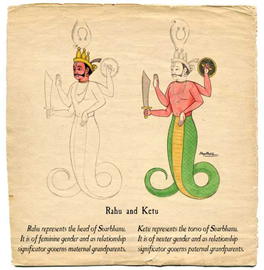
[A 21st century CE illustration of Rāhu and Ketu by Jit Chowdhury, collected from his Mythos series, preserved at Jitch Art Studio (Kolkata, India).]
In the Sanātana Dharma, it is always observed that the male form of the godhead is always accompanied by his female counterpart and vice versa. One cannot perform the pūjā of the male or the female manifestation separately. Unless they are worshipped together, that pūjā would not only go in vain, but can also bring misfortune. Bhṛṅgī is a classic example of this. According to the Śiva Purāṇa, Bhṛṅgī was an ardent bhakta of Śiva and vowed to circumambulate his master only. However, Pārvatī, the consort of Śiva, asked Bhṛṅgī to circumambulate along with her husband, explaining that they are two manifestations of the same being. But, Bhṛṅgī was so adamant to worship Śiva alone that he paid no heed to Pārvatī’s request. Noticing this, Pārvatī sat on her husband’s lap so that Bhṛṅgī had no other choice but to adhere to her demand. However, Bhṛṅgī took the form of a female beetle and started to hover around Śiva alone, ignoring Pārvatī for the third time. This time, Pārvatī got so annoyed by the insolence of Bhṛṅgī that she cursed him to lose all his flesh, muscles, and blood. This made his body collapse. But, because of his devout belief in Śiva, he survived. His master blessed him with another leg to support his body to stand and, at the same time, took the form of ardhanārīśvara (the united figure of Śiva and Pārvatī) to make him realize that the masculine and the feminine hold equal share of the nature.
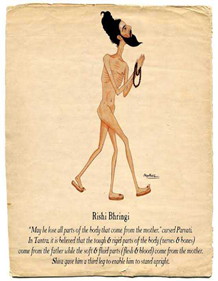
[A 21st century CE illustration of Bhṛṅgī by Jit Chowdhury, collected from his Mythos series, preserved at Jitch Art Studio (Kolkata, India).]
Bhṛṅgī understood his fallacy and prayed to Pārvatī, who blessed him that though he had lost his physical stature, he would be remembered as one of the greatest worshippers of her husband. Thus, Bhṛṅgī’s disability actually inculcates a lesson on the importance of the harmonious coexistence and mutual respect between man and woman.
Whereas it was Pārvatī who got angry in the case of Bhṛṅgī, it was Śiva who got angry at Gaṇeśa for quite a same reason.
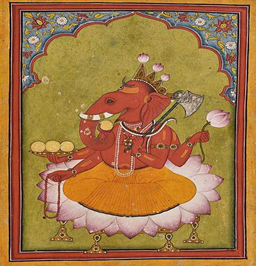
[An 18th century CE bāśoli style painting of Gaṇeśa by an anonymous artist, preserved at the National Museum of India (New Delhi).]
As per the Śiva Purāṇa (2.4.13-18), once upon a time, Pārvatī was preparing to have bath while her husband was out. As there was no one there, she created the figure of a boy from the turmeric paste that she had applied on her body and breathed life and supernatural energy into it. She asked her to stand at the gate and not to allow anyone to come inside while she would have bath. Meanwhile, as this supernatural boy was guarding the honour of Pārvatī (who he considered his mother), Śiva arrived. As the boy did not know who Śiva was, he obstructed his way. Śiva tried to persuade the boy in cordial terms, at first. But, the boy was so obstinate that he refused to entertain him. This resulted in a battle in which the enraged Śiva chopped off the boy’s head. However, Pārvatī, who was childless, became so infuriated by her husband’s action that she threatened to annihilate the entire universe. To console her, Śiva asked his devotees to bring the head of the first creature they would find lying with its head towards the North. They found an elephant in that posture and returned with its severed head. Brahmā, the creator of the universe, adjoined the elephant head on that boy’s body and gave his life back, naming him Gaṇeśa (meaning ‘the chief of the gaṇas’). Thus, Gaṇeśa’s figure of an elephant head and a human body can be regarded as a sort of deformity, though not disability.
Kubjā, as the name suggests in Sanskrit, was another woman with a hunchback. However, unlike Mantharā, she was a very mild and modest woman with her utmost devotion to Kṛṣṇa, as stated in the Bhāgavata Purāṇa (10.39-41).
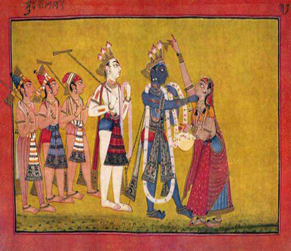
[An 18th Century CE vintage painting of Kubjā with Kṛṣṇa by anonymous artist, collected from the Tallenge Store.]
Refusing Kaṃsa’s warnings, she greeted Kṛṣṇa and Balarāma on their arrival to Mathura. Observing her fearless and unstained devotion, Kṛṣṇa cured her hunchback with his godly powers and made her a beautiful damsel. Thus, Kubjā can be taken as a rare example of a disabled woman turning into a ‘temporarily able-bodied’ being. Whereas previously we found people being cursed to disability, in this case we find a figure being redeemed from it.
From Body to Ātmā
Discourses on the disability studies have sic passim stemmed from outlandishly positing the prime importance to the physique of a person (or of an animal, if spoken from broader perspectives). Thus, the skeletal structure of this discourse is brooded in a physical domain of concern, disposing all tutelage of theosophical nurturing. Despite being subjected to the concern of bodily discrepancies, the field has not been limited to mere medicinal or physiological approaches, but rather it has significantly disseminated in the literary, sociological, and political areas of research. Although the basal differentiation between impairment and disability gave impetus to the dichotomy of social and medical models, the former was adopted as the objectif principal in the penultimate annum of the previous century. Not for long though, as the present era of socio-literary researches have taken a decisive bend towards interdisciplinary methods, the division between the social and medical models has greatly slackened. Although the medical students had studied the disabled in their doctoral curriculum, a revolution hit when Syracuse University introduced the first ever academic course on disability studies in the field of humanities in 1994. It marks a ‘radical departure’ according to Cecilia Capuzzi Simon who observes: “Like black studies, women’s studies, and liberation-movement studies, disability studies teaches that it is an unaccepting society that needs normalizing, not the minority group”. Later in 2005 when the Modern Language Association (MLA) conferred the status of a ‘division of study’ upon the field, it became a widely opted field of research in the humanities in the West. Interesting is it to observe that a field of study that did not even exist (?) thirty years ago has now emerged as a dominant field of research, focusing on the improvement of the quality of life and access to civil rights!
However, like all major fields of academic interest in the humanities, the literature produced by the scholars of disability studies often appears to be ebulliently occidental. For unforeseen reasons, the scholars and academicians in the West have largely overlooked the fascinating accounts on the treatment of disability in the social paradigm that have long existed in the Sanskrit literature. Now, that the historical outline of the recent developments in the field of disability studies in the Western intelligentsia has briefly been mapped, let us venture to introspect the perspectives found in the literature of the Sanātana Dharma.
The doctrine of punarjanma (i.e. the cyclic order of rebirth) is one of the core aspects that construct the backbone behind the philosophy of life and death in the Sanātana Dharma. The body is considered to be transitory whereas the ātmā (which can be loosely translated as the spirit or the soul) is eternal. The pivotal importance, therefore, has to inevitably fall on the ātmā and the body has never been at the centre of the discourse. As the Bhagavad Gītā (2.13) asserts:
देहिनोऽस्मिन्यथा देहे कौमारं यौवनं जरा।
तथा देहान्तरप्राप्तिर्धीरस्तत्र नमुह्यति॥
[After the birth, the body has childhood, youth, and then old age. After the death, the body decays and the ātmā takes birth in another body. Wise people are not bothered by it.]
Śrī Kṛṣṇa has explicated how the transmigration of the ātmā from one body to another is a perpetual function. Anything that is assigned to a birth must also cease in a death. It is the body that inescapably undergoes this process. Therefore, as the mundane body transforms from one period of life to another, it slowly decays and gets perished. However, the ātmā is eternal, without an inception or a conclusion. It persists in its own undiluted and unique form, merely reincarnating from one physical vessel to another. As Śrī Kṛṣṇa states:
न जायते म्रियते वाकदाचिन्
नायं भूत्वा भविता वा न भूयः।
अजोनित्यःशाश्वतोऽयं पुराणो
न हन्यते हन्यमाने शरीरे॥
(Bhagavad Gītā 2.20)
[This ātmā is neither born, nor dies. Its existence is not dependent on the genesis or the apocalypse because the ātmā is beyond both. It is eternal and true. Even when the body decays, it remains.]
Deformity, decay, or disability can only be possible with an object that is ephemeral and goes through transformation. As every bodily affair has these two qualities, they are susceptible to disability. The projection of the ātmā in the Sanātana Dharma is that of an absolute, unchanging, and inexorable being. Through the process of metempsychosis, this being merely transitions its shelter from one physique to another. This lucid, and yet esoteric, notion is vivaciously promulgated with a metaphor:
वासांसि जीर्णानि यथा विहाय
नवानि गृह्णाति नरोऽपराणि।
तथा शरीराणि विहाय जीर्णा-
न्यन्यानि संयाति नवानिदेही॥
(Bhagavad Gītā 2.22)
[Just like one takes off the old ragged clothes and puts on new robes, the ātmā quits the old body and adopts a new one.]
Whereas this palingenesia draws away the focus from the body to the ātmā, an exploration of its nature turns out to be unavoidable in the present discourse of disability. The ātmā is not merely ineffable by verbosity, but it is also intangible. Through intellectual conjecture we may derive to the existence of this being, but no physical substantiation is possible. Therefore, although the nature of the ātmā can never be conspicuously extolled, one comes across a set of its robust characteristics that are mentioned in the Sanātana Dharma which vehemently dispel all a priori possibilities for any sort of disability in it. For instance:
नैनं छिन्दन्ति शस्त्राणि नैनं दहति पावकः।
न चैनं क्लेदयन्त्यापो न शोषयति मारुतः॥
(Bhagavad Gītā 2.23)
[The ātmā cannot be slain by any weapon, nor can the fire burn it. Neither the water can soak it, nor can the air dry it.]
As the ātmā is considered to be the core being that exists in every living aspect, its absoluteness cannot be questioned. At the same time, it is unhindered and unblemished by its surrounding encounters. If there is an object that is absolute by itself and is immune to decimation by any extraneous apparatus, it cannot be disabled. Thus, conceptually, the ātmā cannot be disabled. So, the crux of the discourse can be induced at the ground of theosophy and not on the physical ability. It is always the body (temporarily able or otherwise) that incurs the disability. The ātmā, despite residing within the body, is aloof of disability. Whether the being is temporarily able-bodied or a disabled one, the ātmā reigns sovereign in and over all bodies. The ātmā is not merely beyond all petty drudgeries like rank, status, creed, caste, and ethnicity, but it is also beyond the ambit of disability as well.
From Ātmā to Paramātmā
When the concern for physicality falls, the anxiety for its disability is also shed and, with this, one arrives at the further scope for the discourse. If the ātmā cannot be disabled and it is present in an able-bodied being and a disabled being alike, it brings forth an altogether different dimension over the purview by inserting the possibility for an equal measure of convenience for both the kinds. Thus, the ātmā, which is unambiguously present in every living being without any discrimination, can be referred to as an equalizer between the temporarily able-bodied beings and the disabled ones. Ipso facto, the ground for the sādhanā is, although in veritable domains, identically proportionate to both the compeers.
Hence, if the magnitude of assiduity in the sādhanā or any form of spiritual endeavour is standardized to an equilibrium, one cannot help but ask the perpetually elongated question: ‘What now?’ The literature of the Sanātana Dharma unequivocally answers to it in one simple but profound word: ‘yoga’. However, one must be beguiled by the age-old misconception that yoga refers to the painstaking physical activities (which are actually called āsanas and prāṇāyamas, and are often considered to be an integral part of yoga). It rather implies the union between the ātmā and the paramātmā as the Yājñavalaka Saṃhitā (1.43) indoctrinates:
संयोगोयोगइत्युक्तोजीवात्मपरमात्मनोः
[The adjunction of the ātmā and the paramātmā is called yoga.]
Svāmī Nigamānanda, in his Yogiguru, asserts that yoga is the acme of all kinds of sādhanā. However, the māyā (illusive ignorance) makes us oblivious to the fact that our true identity is that of the ātmā (which is immortal). Thus, we have come to be ascribed as ‘jīva’ (that which is mortal). This, opines the great master, is the root cause that moulds us to be prone to suffering in three dimensions of life, videlicet ādhyātmika (spiritual), adhibhautika (metaphysical), and adhidaivika (celestial). Yoga is the way to emancipate ourselves from the aforementioned pangs by realizing our true identity as an ātmā which is essentially an eternal part of the paramātmā (the supreme self). Practising yoga, one can evade from the clutches of the māyā as it fails to sustain its labyrinth in front of the yogī.
The longing and the strife to know the greater unknown is an innate characteristic of the cognitive faculty of a human being. One, who is ascertained of the fact that the real being or the true self is not merely a mundane element, would instinctively look for the phenomenological account of its greater self or greater identity. This venture eventually leads the seeker to the discovery of the relationship between the subjective self (which is limited) and the sublime self (which is omniscient). The aftermath of this investigation has been eruditely encapsulated in the four mahāvākyas of the Upaniṣads which lay a foundation to understand the functional relationship between the ātmā and the paramātmā. The Chāndogya Upaniṣad (6.8.7) annunciates the dictum of “तत् त्वम् असि” (loosely meaning, ‘that is you’) while exploring the transcendental affinity between the two. The paramātmā (as expressed by the Sanskrit word ‘तत्’, meaning ‘that’) and the ātmā (as expressed by the ‘त्वम्’, meaning ‘you’) are both qualitatively identical. This tattva exterminates all the qualitative differences between these two. Hailing it as the sum and substance of the nature of consciousness in the quantum physics, Erwin Schrödinger, a Nobel Laureate in Physics, asserts in his scientific autobiography titled My View of the World:
Looking and thinking in that manner you may suddenly come to see, in a flash, the profound rightness of the basic conviction in Vedanta…Hence this life of yours is not merely a piece of the entire existence, but in a certain sense the whole. This, as we know, is what the Brahmins express in that sacred, mystical formula which is yet really so simple and so clear: Tat tvam asi (that is you).
Delving deeper into the phenomenon, one may comprehend the assimilation of the ātmā and the paramātmā in the light of the Bṛhadāraṇyaka Upaniṣad (1.4.10) that heralds the second mahāvākya: “अहं ब्रह्मास्मि” (meaning, ‘I am the Brahma, the supreme self’). Whereas in the previous axiom one may dubiously assume that there might be a subdued notion of distance between the ātmā and the paramātmā, the second one vociferously obliterates such a possibility. Realizing this gravest wisdom would unfalteringly embolden the psyche of the able-bodied and the disabled ones alike as the ātmās that reside in them are not merely identical, but have also emanated from the paramātmā. Knowing this not only liberates oneself from ignorance, but also casts light on the profundity of the ‘knowing’ as this leads to the immersion of the limited self in the supreme self. That is why Aitareya Upaniṣad (3.3) inscribes: “प्रज्ञानं ब्रह्म” (meaning, ‘knowing is Brahma’). The cognizance of the apothegm that the self is, in fact, the supreme self as it is a part of it, just like a drop of water in the ocean is not merely a part of it, but it is the ocean itself in quality. Therefore, the Māṇḍukya Upaniṣad (1.2) inculcates: “अयम् आत्मा ब्रह्म” (meaning, ‘I am the ātmā that is the paramātmā’).
Apart from these, the other mahāvākyas such as “सोऽहम्” (meaning, ‘that is me’) in the Īśa Upaniṣad (16); “सर्वं खल्विदं ब्रह्म” (meaning, ‘Brahma is everywhere and in everything’) in the Chāndogya Upaniṣad (3.14.1); “एकमेवाद्वितीयं ब्रह्म द्वितीयो नाsस्ति” (meaning, ‘there is only one Brahma and no other’) in the Chāndogya Upaniṣad (6.2.1); and “एतद् वै तदक्षरं” (meaning, ‘this is that and that is that’) in the Bṛhadāraṇyaka Upaniṣad (3.8.8) also veritably herald the aphorism that the ātmā and the paramātmā are essentially inseparable. Therefore, the ātmā that resides in an able-bodied being and the ātmā that resides in a disabled being are not only equal and identical, but also enjoy same patronage.
Conclusion
Whereas the whole article has discussed the concerns of disability from the backdrop of physicality, a discourse on the cognitive or psychological disability has been dodged. Whether the people suffering from psychological disability (such as schizophrenia, catatonia, and dementia et cetera) can also be regarded as equal counterparts to the physically disabled ones is a vast field yet to be explored. Observing the outcomes of the research findings in the present article, one might surmise that the literature of the Sanātana Dharma may add another new dimension in the discourse of disability with a trailblazing take on the subject. However, such a discussion would undoubtedly require another full-fledged article on it. Having said this, the able-bodied and able-minded beings may pray for themselves and for the physically disabled and the psychologically disabled beings too as the śanti mantra of the Praśna Upaniṣad directs:
ॐ भद्रंकर्णेभिः श्रुणुयामदेवा भद्रं पश्येमाक्षभिर्यजत्राः।
स्थिरैरङ्गैस्तुष्टुवा ̐˴सस्तनूभिर्व्यशेम देवहितं यदायुः॥
स्वस्ति न इन्द्रो वृद्धश्रवाः स्वस्ति नः पूषा विश्ववेदाः।
स्वस्ति न स्तार्क्ष्योअरिष्टनेमिः स्वस्ति नो बृहस्पतिर्दधातु॥
॥ ॐ शान्तिः शान्तिः शान्तिः ॥
[O divine! May our ears hear what is good, may our eyes see what is beautiful, may our organs be serviceable to wellbeing, and may our lifespan be spent in doing good deeds. May Indra, the lord of the heaven, protect us; may Sūryadeva, the lord of the sun and the solar system, cherish us. May Garuḍa, the cosmic vehicle-bird of Viṣṇu, diminish our viciousness. May Bṛhaspati, the guru of the divine wisdom, enlighten us. May there be śāntiḥ (cosmic peace) of the three tāpas— the ādhyātmika, the adhidaivika, and the adhibhautika.]
Works Cited
- Aitareya Upaniṣad. Gita Press. 2021.
- Al-Aoufi, Hiam et al. “Islam and the cultural conceptualisation of disability”. International Journal of Adolescence and Youth, Vol. 17, No. 4, December 2012, pp. 205–219. Https://www.tandfonline.com/doi/full/10.1080/02673843.2011.649565
- Bhagavad Gītā. Gita Press, 2014.
- Bible: New Testament and Psalms. The Gideons International, 2015.
- Bṛhadāraṇyaka Upaniṣad. Gita Press. 2021.
- Chāndogya Upaniṣad. Gita Press. 2021.
- Desikachar, TKV, translator. Yogayājñavalaka Saṃhitā. Chennai: Krishnamacharya Yoga Mandiram, 2015.
- Garland, Robert. “How Was A Disabled Greek Person Treated in Society?”. Wondrium Daily, 21 October 2020.https://www.wondriumdaily.com/how-was-a-disabled-greek-person-treated-in-society/
- Īśa Upaniṣad. Gita Press. 2021.
- Māṇḍukya Upaniṣad. Gita Press. 2021.
- Nigamānanda, Svāmī. Yogīguru. Sri Sri Saraswat Math. Assam: Assam Bangiya Saraswat Math, 2005, p. 17.
- Otieno, Pauline A. “Biblical and Theological Perspectives on Disability: Implications on the Rights of Persons with Disability in Kenya”. Disability Studies Quarterly, vol. 29 no. 4, 2009.https://dsq-sds.org/article/view/988/1164
- Praśna Upaniṣad. Gita Press. 2021.
- Qur’an. Al-Muntada Al-Islami Trust, 2012.
- Schrödinger, Erwin.My View of the World. CUP, 1964, p. 21.
- Simon, Cecilia Capuzzi. “Disability Studies: A New Normal”. The New York Times, 01 November 2013. https://www.nytimes.com/2013/11/03/education/edlife/disability-studies-a-new-normal.html
- Vālmīki. Rāmāyaṇa. Gita Press, 2015.
- Vyāsa. Bhāgavata Purāṇa. Gita Press, 2006.
- Vyāsa. Mahābhārata. Gita Press, 2017.
- Vyāsa. Śiva Purāṇa. Gita Press, 2020.
