
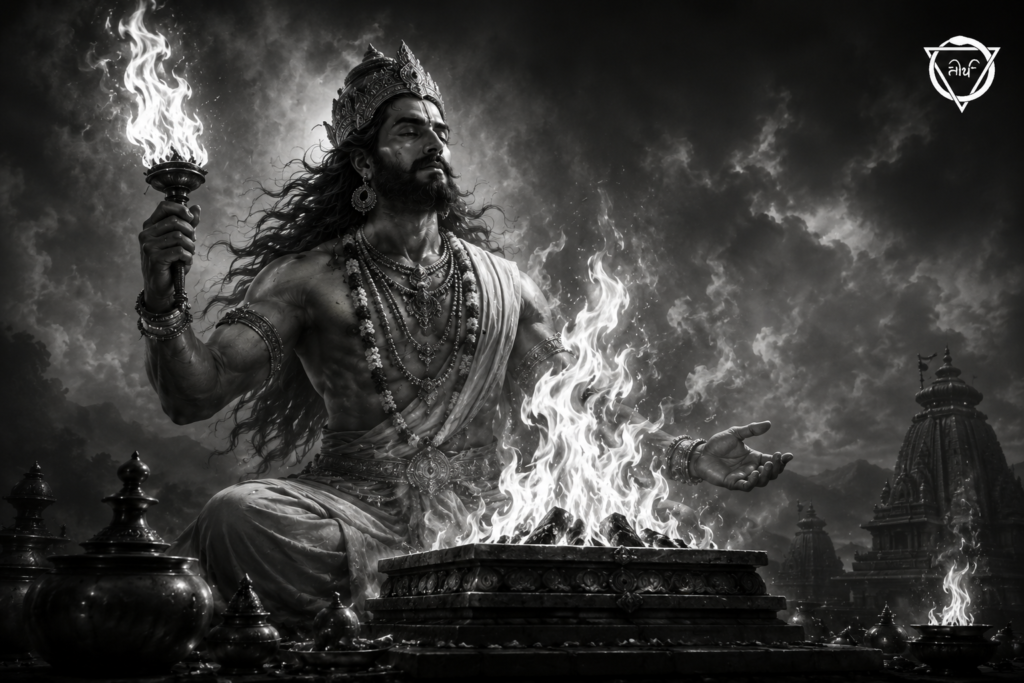
Agni as the representative of all deities, “the mouth of the gods” (devānām mukham) and the first-born of ṛta. Agni is the principle of manifestation, the luminous energy through which the transcendental becomes immanent. His svarūpa (being) is tejas— the conscious force which is radiant in every activity. Agni not merely as physical fire but as the universal zeal to realize the urge of consciousness towards form (within and without).
- Adhidaivika: Agni is the intermediary between gods and men, the dūta (messenger), embodying ṛta in motion. In this cosmic role, he is the rhythm of transformation that carries the oblations of existence to the higher planes.
- Adhibhautika: On the material level, Agni is the energy latent in all phenomena— from the fire and the heat to the metabolism and lightning— symbolizing the dynamic matrix of creation. He represents the fiery principle by which matter is animated and purified.
- Adhyātmika: Within the individual (human being), Agni is jāṭharāgni (flame of digestion) and buddhāgni (the cognitive ability / the light of wisdom). Agni is the first awakening of consciousness in the aspirant: the spark that kindles aspiration and sacrifice (yajña). Thus, Agni becomes the psycho-spiritual energy that burns ignorance into illumination.
The Vaidika yajña is the drama of this inner fire. As man offers the fragments of his being into Agni, he participates in the cosmic act of transformation. “Agni is the pilgrim in man’s soul,” Anirvan writes, “the traveller who leads from darkness to light”. Hence, Agni symbolizes self-offering, purification, and the ascent of consciousness— the eternal movement from potentiality to realization.
