
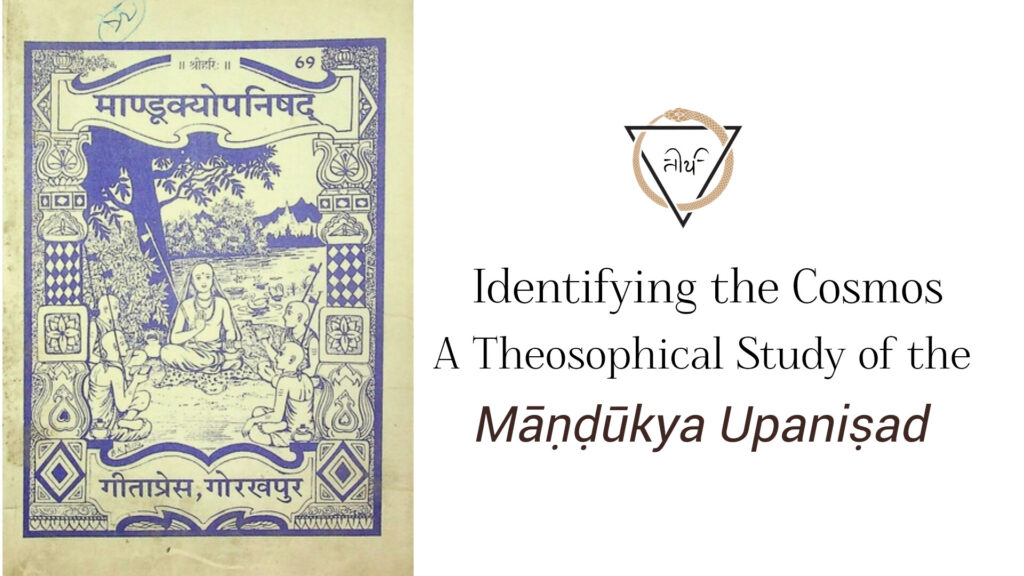
Abstract
Whereas all major theosophical literatures of the Abrahamic religions have pondered over the act of creation and the cataclysm of the cosmos, none did ever venture to scientifically elucidate its identity. Let alone be Abrahamic faiths, tracing the identity of the cosmos has also lurked in obscurity even in the pagan and heathen cultures that flourished in ancient Europe which were much more scientific than the formerly mentioned religions. However, the Sanātana Dharma which anchors in the Veda is conspicuously unique in this prospect. Time and again, it has succinctly demystified, inter alia, the orchestration and the identity of the cosmos. The Māṇḍūkya Upaniṣad is one of such seminal texts of the Sanātana library which can be taken into account in this regard. Although it is the puniest of all its denominations, it possesses a stark contrast when it comes to significance and merit. In this paper, I shall endeavour to analyze how this classical text has linked the bridge between the theosophy and modern physics in tracing the identity of the cosmos. This paper exemplifies qualitative research and the library method has been applied to substantiate the claims that it makes. As the original text is in Sanskrit, citations will either be transliterated by using the International Method of Sanskrit Transliteration (IAST), or they will be pasted in toto as they are for the sake of the scholarly purpose. The paper lucubrates on the identity of the cosmos in the aura of the Sanātana theosophy.
Keywords: Brahma; Cosmos; Mass; Energy; ॐ
Introduction
In the Sanātana Dharma, there has been a prevalence of the analogy that whereas the Vedas are like a cow, the Upaniṣads are like the milk she produces. The profundity of the Vedas can be magnanimous for the multifarious acts of life, but the laconic compendia of the esoteric theosophy and cognitive formulae that are found in the Upaniṣads, the conclusive parts of the Vedas, are the essence of the scientific discourse. Whereas all the Upaniṣads aim at the anagnorisis of the scientific wisdom (from the atomic and subatomic particles to the extraterrestrial phenomena), the Māṇḍūkya Upaniṣad succinctly lays bare the theosophical contemplation of the cosmological identity.
The very inception of the Māṇḍūkya Upaniṣad is trailblazing as the first śloka unequivocally heralds that the entire cosmos is filled by the supreme akṣara known as the ‘ॐ’ and the cognizance of this fact has been celebrated as the purpose of the following ones. The past, the present, and the future of the cosmos are linked to this identity. The cosmos has its origin, function, and dissolution in the supreme being called the Brahma and its denominative form is the ‘ॐ’ itself:
ॐ इत्येतदक्षरमिँ सर्वंतस्योपव्याख्यानं
भूतंभवद्भविष्यदिति सर्वमोङ्कार एव
यच्चान्यत्त्रिकालातीतं तदप्योङ्कार एव ॥
(Māṇḍūkya Upaniṣad 1)
[The entire cosmos is the explicative form of the supreme akṣara called ‘ॐ’ and although it is beyond the cycle of time, it regulates the past, present, and future.]
Despite the fact that this supreme being regulates the cycle of time, it is aloof of the time’s clutch. All the dimensions (including time) have sprung from this ‘ॐ’ and will dissolve into it. Although it is compact, absolute, and infinite by itself, its virtues will remain unhindered even when they are withdrawn from it. Paradoxical and self-contradictory it may sound, but it has been reiterated in the Bṛhadāraṇyaka Upaniṣad (5.1.1):
ॐ पूर्णमदः पूर्णमिदं पूर्णात् पूर्णमुदच्यते ।
पूर्णस्य पूर्णमादाय पूर्णमेवावशिष्यते ॥
ॐ शान्तिः शान्तिः शान्तिः ॥
[The eternally blissful and the self-fulfilled Brahma is infinite and this cosmos is also filled by its infiniteness as it has originated from that self. Even if the infiniteness from the infiniteness is taken away, infiniteness shall remain.]
The reason which lies behind this epigrammatic statement is that infinity and absoluteness cannot be measured and nothing can exist beyond them. Therefore, withdrawing something from the infinite is actually supplying the infinity at the same time. As Mahānāmavrata Brahmacārī rightly illustrates:
The ॐ has no end, nor any beginning. It is the Brahma. It is the sound and the silence both…It is the first and the last śabda (word), the first and the last pratīka (symbol), and the first and the last of the sattva (essence). It is the be-all and the end-all of the cosmos. It does not have any meaning of its own as it is the source of all meanings. (Veda Vicintan, p. 293)
The entire cosmos is, de facto, nothing but the incarnation of the Brahma. It is the Brahma that comprises the mass and the spirit en tout as validated by the Bṛhadāraṇyaka Upaniṣad (3.7.23):
योरेतसि तिष्ठन्रेतसोऽन्तरोय ̐˴रेतोनवेदयस्य रेतः
शरीरं योरेतोऽन्तरोयमयत्येष त आत्माऽन्तर्याम्यमृतोऽदृष्टो
द्रष्टाऽश्रुतः श्रोताऽमतोमन्ताऽविज्ञतोविज्ञाता।
नान्योऽतोऽस्ति द्रष्टा नान्योऽतोऽस्ति श्रोता
नान्योऽतोऽस्तिमन्ता नान्योऽतोऽस्ति विज्ञातैष
त आत्माऽन्तर्याम्यमृतोऽतोऽन्यदार्तं
ततोहोद्दालक आरुणिरुपरराम ॥
[The Brahma sees everything, but it cannot be seen; it hears everything, but it cannot be heard; it thinks everything, but it cannot be thought of; it knows everything, but it cannot be known. Except it, none actually sees, hears, thinks, and knows anything. It resides in us as the ātmā which is immortal.]
The abovementioned śloka implies that the Brahma is the body and the spirit of the cosmos. It is omnipresent, omnipotent, and omniscient. It is one and absolute. However, the second śloka of the Māṇḍūkya Upaniṣad infers four salient features of the supreme spirit. Although the Brahma is undividable, these features meticulously help us to conceive an idea of the one who is beyond all conception, only for the sake of mundanely scientific understanding. These features can together be framed as a notion of the identity of the cosmos. They are expounded below.
वैश्वानरः — the Cosmic Mass
The Law of Conservation of Mass discovered by Antonio Lavoisier in 1789 asserts that the “mass is neither created nor destroyed in chemical reactions. In other words, the mass of any one element at the beginning of a reaction will equal the mass of that element at the end of the reaction” (Sterner et al., 2011). It would not be a hypothetical exaggeration to state that the theory behind the concept of the ‘वैश्वानरः’ (Vaiśvanaraḥ) proposed by the third mantra of the Māṇḍūkya Upaniṣad also indicates the same notion:
जागरितस्थानो बहिष्प्रज्ञः सप्ताङ्ग एकोनविंशतिमुखः
स्थूलभुग्वैश्वानरः प्रथमः पादः ॥
[Life, mind, senses, sound, air, fire, water, and earth have originated from the Brahma. This is the physical manifestation of the Brahma and the first of its features. As it is a part of the Brahma, it is absolute.]
The abovementioned mantra enunciates that the sthula (materialist) aspect of the cosmos is the first pāda of the Brahma. The seven lokas (viz. the bhūḥ or the earth; the bhuvaḥ or the region between the earth and the sun; the svaḥ or the heavenly constellation between the seven stars and the sun; the mahaḥ or the region preceding the seven stars; the jana or the region of the seven stars; the tapaḥ or the ethereal sphere of the cosmos; and the satya or the region of the creation of the universe) are the materialist aspects of the Brahma. However, the reader must be cautioned that the Brahma is beyond the limitations of these aspects as it is the abode of these celestial elements. Apart from them, in our mundane lives, the five jñāna indriyas (the five sensory organs), the five karma indriyas (the five acting organs), the five prāṇas (the five elementary airs), and the four karaṇas (the four dimensions of the self) are also considered as the nineteen faces of the Vaiśvanaraḥ who relishes and feels every physical aspect. This is why the sthula aspect of the Brahma is called ‘वैश्वानरः’ (the cosmic mass). It can be referred to Śrī Kṛṣṇa’s explication of this notion in the Bhagavad Gītā (5.29 and 9.24) where he perspicuously asserts that everything of the cosmos that are found as physical entities actually resides in the body of the Brahma:
भोक्तारं यज्ञतपसां सर्वलोकमहेश्वरम्।
सुहृदं सर्वभूतानां ज्ञात्वा मां शान्तिमृच्छति।।
…………………………………………………………
अहं हि सर्वयज्ञानां भोक्ता च प्रभुरेव च।
न तु मामभिजानन्ति तत्त्वेनातश्च्यवन्ति ते।।
[My devotee knows me as the cosmic consumer of all the aspects of the universe as I am the constitution of the cosmos. Knowing this, my devotee remains good-hearted, unselfish, kind, and amicable to all. He, who does not know that I am the constitution and the lord of the cosmos, is doomed into the darkness of ignorance which results in the recycle of life.]
As the mass of the cosmos is actually the physical manifestation of the Brahma, it is inevitably absolute and can neither be created, nor be destroyed– just like Antonio Lavoisier stated in his theory that is mentioned ab initio of this segment. However, it is worth mentioning that the greatest theologian and philosopher of the 8th century CE and the preacher of the Advaita Vedānta, Ādi Śaṅkāracārya, had already enucleated this in his bhāṣya (commentris) on the Brahmasūtraṃ. In his commentaries (1.2.24), he writes the mantra:
ॐ वैश्वानरः साधारणशब्दविशेषात् ॐ ॥
[The Vaiśvanaraḥ is the general word for (one of the) aspects the cosmic person or the supreme lord.]
The conversation between Aśvapati Kaikeya and the five metaphysical theologians mentioned in the Chāndoyga Upaniṣad (5.11-18) reiterates the term ‘वैश्वानरः’ multiple times and exuberantly illustrates the various domains of the notion. The five theologians are Aupamanyava, Pouluṣi, Bhāllaveya, Jana, and Buḍila respectively. They all were looking for the answer to the grand question: ‘What is our self and what is the Brahma?’ So, these five theologians united and approached sage Uddālaka Āruṇi, who directed them to the king called Aśvapati Kaikeya, who satisfied their quest for the sacred wisdom by elaborating the notion of the ‘वैश्वानरः’ in a question-answer segment.
Aśvapati first enquired Aupamanyava whom he worshipped as the Ātmā Vaiśvanaraḥ (the cosmic mass), to which he replied that he hails dau (the soil) as such. King Aśvapati corrected him saying that the dau whom he worshipped is actually only the mūrdhā (head) of the Ātmā Vaiśvanaraḥ, not the entire self. He then asked Pauluṣi the same question and his answer was āditya (sunbeam or fire). Aśvapati corrected him saying that it is only the cakṣu (eyes) of the Ātmā Vaiśvanaraḥ, not the entire self as well. The king then reiterated the question to the third of the theologians, Bhāllaveya, and he answered that he considered vāyu (air) as the Ātmā Vaiśvanaraḥ. But the king rectified him, explaining that it is only the prāṇa (heart), not the whole self. Then the fourth theologian, Jana, was also asked the same question and his answer was ākāśa (firmament). Aagin, the king explained that it is only the upper torso of the Ātmā Vaiśvanaraḥ, not the entire self. The fifth theologian, Buḍila, was asked the same question and his answer came as jala (water). The king corrected him too, saying that it is only the lower torso of the Ātmā Vaiśvanaraḥ, not the whole self. Much like the famous parable of the Blind Men and the Elephant which was first depicted in the Ṛgveda (Giffiths, pp. 46-47) and later became the source of John Godfrey’s poem with the same title as the parable, king Aśvapati eventually enlightens them by clarifying the misunderstanding of their specific approaches and proposed a holistic view.
He clarified that all the brāhmaṇas were contemplating on the partial apparatus of the Brahma. He then inculcated them with the true nature of the omnipresent Brahma and this sacred wisdom has been hailed as the Vaiśvanaraḥ Vidyā:
तान्होवाचैतेवैखलु यूयं पृथगिवेममात्मानं
वैश्वानरं विद्वाꣳसोऽन्नमत्थ यस्त्वेतमेवं
प्रादेशमात्रमभिविमानमात्मानं वैश्वानरमुपास्तेस सर्वेषु
लोकेषुसर्वेषुभूतेषुसर्वेष्वात्मस्वन्नमत्ति ॥
तस्य ह वा एतस्यात्मनोवैश्वानरस्य मूर्धैव
सुतेजाश्चक्षुर्विश्वरूपः प्राणः पृथग्वर्त्मात्मा संदेहो
बहुलोबस्तिरेव रयिः पृथिव्येव पादावुर एव वेदिर्लोमानि
बर्हिर्हृदयं गार्हपत्योमनोऽन्वाहार्यपचन आस्यमाहवनीयः॥
[All of you have been contemplating upon the different limbs of the Vaiśvanaraḥ rather than its entire form. Until and unless one realizes that it is the Vaiśvanaraḥ which constitutes everything and that everyone resides in it, the person’s intellect remains confined to a narrow dogma. The sun is the head of the Vaiśvanaraḥ, the world is its eyes, and the umpteenth numbers of the spirits or the cosmic elements constitute its torso. The force is its abdomen, the soil is its feet, wisdom is its chest, the mountains are its hair, the fire of the household is its heart, the fire of the pyre is its mind, and the fire of the earth is its mouth.]
तैजस: — The Cosmic Energy
The law of conservation of energy, which is regarded as an integral part of theoretical physics and quantum thermodynamics, was first discovered and tested by the Newtonian scientist, Émilie du Châtelet. It states that “energy can neither be created, nor destroyed – only converted from one form of energy to another. This means that a system always has the same amount of energy” (Campbell et al., 2020). Quite similar a theorem is also stated in the fourth mantra of the Māṇḍūkya Upaniṣad where the cosmic energy has been considered as absolute and infinite:
स्वप्नस्थानोऽन्तःप्रज्ञः सप्ताङ्ग एकोनविंशतिमुखः
प्रविविक्तभुक्तैजसो द्वितीयः पादः॥
[Intangible and abstract is the state of the energy. Its wisdom has filled the cosmos. With its seven limbs and nineteen mouths, it consumes everything. This energy belongs to the hiraṇyagarva and it is the second feature of the Brahma.]
The Sanskrit term ‘तैजस:’ refers to the cosmic energy and it has been considered as the second pāda of the Brahma. The cosmic energy or the nimbus is the reason behind the prakāśa (function) of all the objects. In different texts of the Sanātana Dharma, it has been ascribed with different nomenclatures such as the ‘jyoti’ (luminosity) and ‘hiraṇyagarva’ (the auriferous light). For instance, the Taittrīya Brāhmaṇa (3.12.9.7) terms it ‘येनसूर्यस्तपतितेजसेद्धः’ (the burning fire of the sun) and Chāndoyga Upaniṣad (3.13.7) delineates it as the ‘पुरुषेज्योतिः’ (the aura of god):
अथ यदतः परोदिवोज्योतिर्दीप्यतेविश्वतः पृष्ठेषु
सर्वतः पृष्ठेष्वनुत्तमेषूत्तमेषुलोकेष्विदं वाव
तद्यदिदमस्मिन्नन्तः पुरुषेज्योतिः॥
[The luminous aura that is found in every sublime sphere of the cosmos has originated from the aura of the Brahma. It is the same energy that also resides as the spirit in the body.]
This cosmic energy is sūkṣma (exquisitely subtle) and it cannot be measured or comprehended by the mundane beings. It is as mystical and cunning as a dream. It is the source of the spur for all the actions that take place in the cosmos. In other words, it is this śakti that runs the cosmic functions. That is why Ādi Śaṅkarācārya in his commentaries on the Brahmasūtraṃ (1.1.24) has held it with great reverence:
ॐ ज्योतिश्चरणाभिधानात् ॐ ॥
[The jyoti or the light is the Brahma and it is the energy of the cosmos.]
This ‘तैजस:’ is inexorable and unfathomable as it is the second aspect of the Brahma. Therefore, the parallel drawn between this theosophical notion and the empirical scientific law of the conservation of energy is justified and validated.
प्राज्ञ: — The Cosmic Everything
Dr. Michio Kaku, a professor of theoretical physics at the City University of New York and one of the foremost physicists of the present generation, notes in the beginning of his latest title, The God Equation: The Quest for a Theory of Everything, that it was Albert Einstein’s unfinished dream to find one equation that would describe everything— a mission which latter physicists termed as ‘the theory of everything’. Albert Einstein’s most talked about equation in the theoretical physics of special relativity (i.e. E = mc2) is also termed as the ‘mass-energy equivalence’ as it scientifically proves that mass and energy are “intimately related” (Rodgers, 2014). To simplify the theory, it can be said that when energy is condensed, it takes the form of mass and, alternatively, when mass is exploited, it takes the form of energy. This incomprehensible “intimately related” state of the mass and energy is astonishingly similar to the implication of the Sanskrit word ‘सुषुप्त:’ used in the fifth śloka of the Māṇḍūkya Upaniṣad. This esoteric wisdom has been hailed as the ‘प्राज्ञ:’ or ‘the cosmic everything’ as it is the state when mass and energy is not considered as separate entities, but rather as one and uniform. It states:
यत्र सुप्तो न कञ्चन कामं कामयते नकञ्चन स्वप्नं पश्यति तत्सुषुप्तम्।
सुषुप्तस्थानएकीभूतः प्रज्ञानघन एवानन्दमयोह्यानन्दभुक्चेतोमुखः प्राज्ञस्तृतीयः पादः॥
[Where there is no desire, no illusion, and no enchantment, that slumberous, tranquil, wise, and blissful state is omniscient. Its physicality is derived from the condensation form of the ānanda or energy and therefore it is a dream-like state. It is the third feature of the Brahma.]
In this śloka, it is implicated that the third pāda of the Brahma is the “intimately related” state of the dormant energy that is there within the mass. It is the omnicompetent, omnipresent, and omniscient aspect of the cosmic functionality as per the Māṇḍūkya Upaniṣad. That is why, it has been called as the ‘प्राज्ञ:’ or the cosmic everything (or cosmic all-knowing). By this term, the omniscient Brahma has been venerated as it is the one behind the creation of the cosmos. In some texts of the Sanātana Dharma, it has been ascribed as the ‘ānanda’ (the cosmic ecstasy) and ‘sat’ (the eternal). By this mantra, not only the nature of the paramātmā (the cosmic spirit), but that of the jīvātmā (the human spirit) has also been explicated. However, since the latter resides in the former, the term ‘प्राज्ञ:’ is more convivially applicable to the latter. As Ādi Śaṅkāracārya in his commentaries on the Brahmasūtra (1.3.42) asserts that as the virtue of omniscience belongs to the supreme spirit, the term ‘प्राज्ञ:’ depicts the ‘सुषुप्त:’ nature of the Brahma:
ॐ सुषुप्त्युत्क्रान्त्योर्भेदेन ॐ॥
[Because of the declaration of being different in sleep and at the time of departure, the Brahma is the subject matter of teaching.]
Apart from this, the great master of Advaita Darśana has also deciphered this aspect with terms like ‘prajñānighana’ and ‘ānandamaya’ which mark them assigned to the omniscient Brahma. That is why, the sixth mantra of the Māṇḍūkya Upaniṣad further enunciates:
एष सर्वेश्वरः एष सर्वज्ञ एषोऽन्तर्याम्येषयोनिः सर्वस्य
प्रभवाप्ययौ हि भूतानाम् ॥
[It is the god of gods, it is omniscient. It is self-fulfilled and the reason behind every function of the universe. Creation, preservation, and destruction all happens because of this and within this.]
The abovementioned śloka demonstrates that this Brahma is the ‘सर्वेश्वरः’ (the god of gods) who is all-pervasive and the sole cause of function of the cosmos. Therefore, the previously uttered words such as the ‘वैश्वानरः’, ‘तैजस:’, and ‘प्राज्ञ:’ are actually bynames of the one and absolute Brahma.
अचिन्त्य: —The Cosmic Nothing
Whereas Einstein’s theory could explain the macrocosmic phenomena of the universe, the microcosmic phenomena can only be described properly by the quantum theory which was first suggested by another Nobel laureate physicist named Max Planck. Later, physicists like Bohr, Schrӧdinger, Heisenberg, Feynman, Louis de Broglie, and many others developed this theory which holds a probabilistic view of the cosmos. Nearly all of them were heavily influenced by the Upaniṣads. But, most importantly, it is the Nobel Prize winning physicists like Schrӧdinger, Heisenberg, and Bohr, who openly embraced the notions of the Vedānta. For instance, the German physicist, Dr. Hans-Peter Dürr, whose research works attune with Ādi Śaṅkāracārya’s theory of māyā, asserts while discussing on the quantum theory: “I studied the matter for the last 35 years, only to find out that it does not exist! I have been studying something that does not exist” (Sri Sri Ravi Shankar, 2012). Now, let us proceed to the next śloka of the Māṇḍūkya Upaniṣad:
नान्तःप्रज्ञं न बहिष्प्रज्ञं नोभयतःप्रज्ञं नप्रज्ञानघनं
न प्रज्ञं नाप्रज्ञम्। अदृष्टमव्यवहार्यमग्राह्यमलक्षणं
अचिन्त्यमव्यपदेश्यमेकात्मप्रत्ययसारं प्रपञ्चोपशमं
शान्तं शिवमद्वैतं चतुर्थं मन्यन्ते स आत्मा स विज्ञेयः॥
[It neither knows the inside, nor the outside. It knows no side. It is nowhere. It knows nothing. It does not see, nor can it be seen. It cannot be used. It cannot be accepted. It does not have any feature or aspect. It cannot be thought of. It is not located anywhere. The only proof of its existence is itself because it does not exist. It is the tabula rasa, non-dual, and it is the summum bonum. One, who knows this feature of the Brahma that it cannot be known, is a wise man.]
It dilates that the fourth pāda of the Brahma is that it is neither knowledgeable from the intrinsic cognition, nor from the extrinsic one; neither it conceives, nor can it be conceived; it is neither conscious, nor unconscious; it cannot be exploited or used by anyone or any means; it cannot be accepted by anyone; it does not have any characteristic; it cannot be understood by thinking; it cannot be seen or visualized in any form; it exists, and it does not exist; it is the all-pervasive summum bonum that is surrounded by a state like tabula rasa; it is formless, shapeless, unseen, unobservable, inaudible, and non-dual. In brief, it is the ‘nirguṇa nirākāra’ aspect of the Brahma— the kind of hypotheses that quantum physicists put forward as the identity of the cosmos.
With the proliferative mathematical equations and hypotheses on the intriguing phenomena such as the black holes, the dark matter, and the dark energy, the implication of the constant employment of negating epithets in this śloka of the Māṇḍūkya Upaniṣad has regained prominence and garnered much discussion in the community of philosophers as well as physicists. As a result, the cosmic nothingness has emerged as a bona fide field of study in the academia and many contemplate it as the ‘next big thing’ in astrophysics. Tim Folger, the winner of the American Institute of Physics Science Writing Award (2007), espouses the view that “when the next revolution rocks physics, chances are it will be about nothing— the vacuum, that endless infinite void…Empty space wasn’t always so mystifying. Until the 1920s physicists viewed the vacuum much as the rest of the rest of us still do: as a featureless nothingness, a true void. That all changed with the birth of quantum mechanics” (2008).
ॐ — The Theosophical Theory of Everything
“I want to know how God created this world”, said Albert Einstein in 1925, “I’m not in this or that phenomenon. I want to know His thoughts; the rest are just details” (Lincoln, 2019). It was Einstein’s audacious attempt to eventually reach to one conclusive equation in theoretical physics that would encapsulate all the mechanisms that lay behind all the functions of the cosmos. After Einstein’s demise, Stephen Hawking had initially carried this work of developing a theory of everything, but he abandoned the project, stating that “our search for understanding will never come to an end and that we will always have the challenge of new discovery. Without it, we would stagnate” (2002). However, physicists have not utterly defenestrated the search for such a theory and, as a result, the string theory (with all its variations and limitations) have emerged as the latest theory. It is the only theory which applies the laws of the quantum theory and the theory of relativity in amalgamation and poses a mathematical hypothesis which inclines to win the coveted title. But the problem with string theory is that it cannot be tested physically and it seems very unlikely to be tested in near future as well.
Thus, laying bare the aftermath of the endeavour of the physicists by far, one might embark to galvanize a theory of everything from the theosophical perspective. Here comes the role of Māṇḍūkya Upaniṣad as it distinctively puts forward ‘a theosophical theory of everything’:
सोऽयमात्माध्यक्षरमोङ्कारोऽधिमात्रं पादा मात्रा मात्राश्च पादा
अकार उकारो मकार इति ॥
[That Paramātmā (the supreme being), whose four pādas (features) have been described before, has three mātrās (dimensions) and it is not separate from those three. These three mātrās are the ‘अ’ or the ‘a’ sound, ‘उ’ or the ‘u’ sound, and ‘म’ or the ‘m’ sound respectively.]
It is the ‘ॐ’ which has been hailed as the be-all and the end-all of everything. It is both sākāra (formative) and nirākāra (formless). The three mātrās (i.e. ‘अ’, ‘उ’, and ‘म’) are the formative structure of the cosmos, all embodying different aspects. The ‘ॐ’ is regarded as the ‘प्रणव:’ that is formed by three phonetic sounds: ‘अ’, ‘ऊ’, and ‘म’ (a-u-m). These three sounds are symbolically encrypted, each representing three different aspects. The first sound ‘अ’ (a) stands for Brahmā who is the ‘नाद’ (sound of creation); the second sound ‘ऊ’ (u) stands for Viṣṇu who is the ‘बिन्दु’ (the preserver or container which nurtures the creation); and the last sound ‘म’ (m) stands for Śiva who is the ‘कला’ (the art of destruction). Commingled together, they become the “ब्रह्मज्योति” (the Supreme Being). As Svāmī Nigamānanda has inculcated in his magnum opus, Yogīguru (p. 36):
शिवो ब्रह्मा तथा विष्णुरोङ्कारे च प्रतिष्ठिता:।
अकारश्च भवेद्व्रह्मा उकारः सच्चिदात्मकः॥
मकारो रुद्र इत्युक्तः शीक्षाध्यायः इति उच्यते॥
[According to the true teaching of wisdom, Brahmā, Viṣṇu, and Śiva are together called the ‘ॐ’ in which the ‘अ’ stands for Brahmā, the ‘ऊ’ stands for Viṣṇu, and the ‘म’ stands for Śiva.]
The Māṇḍūkya Upaniṣad interprets the three mātrās of the ‘ॐ’ as three cosmological phenomena which act as constituents:
जागरितस्थानो वैश्वानरोऽकारः प्रथमामात्रा ऽऽप्तेरादिमत्त्वाद्
वाऽऽप्नोति ह वै सर्वान्कामानादिश्च भवति य एवं वेद ॥९॥
[The first mātrā ‘अ’ is the root of all the physical manifestations of the cosmos and it is called the ‘वैश्वानरः’. In other words, it is the bodily aspect of the cosmos. One who knows it, that person becomes fulfilled in all aspects.]
As the śabda (sound) ‘अ’ has a very subtle presence in all the words of the cosmos as it is the root of all sounds. That is why, in the Aitareya Āraṇyaka (2.3.6) of the Veda, it has been asserted: “अकारो वै सर्वा वाक्” (all sounds stem from the ‘अ’ sound). Śrī Kṛṣṇa in the BhāgavadGītā (10.33) has also stated that among all the akṣaras, he is the ‘अ’ sound. As the ‘अ’ sound refers to the physical form of the cosmos, it is also called the first pāda or the body of the Brahma which was previously termed as the ‘वैश्वानरः’. In other words, the ‘वैश्वानरः’ is abbreviated as the ‘अ’ of the ‘ॐ’ sound.
The tenth mantra of the Māṇḍūkya Upaniṣad explains that the second mātrā ‘ऊ’ symbolizes the intangible energy of the cosmos:
स्वप्नस्थानस्तैजस उकारो द्वितीया मात्रोत्कर्षात्
उभयत्वाद्वोत्कर्षति ह वै ज्ञानसन्ततिं समानश्च भवति
नास्याब्रह्मवित्कुले भवति य एवं वेद ॥१०॥
[The second mātrā ‘ऊ’ is the root of all the intangible energetic features of the cosmos and it is called the ‘तैजस:’. In other words, it is the energy of the cosmos. One who knows it, that person excels in attaining the true wisdom.]
This ‘ऊ’ is the second pāda of the Brahma and it is the source of all the energy of the cosmos. In other words, it is energy itself. It has been called a ‘dream like state’ in the Māṇḍūkya Upaniṣad due to its extreme subtlety, intangibility, and abstractness— drawing a parallel with theoretical physics where we have already discovered that energy is always a subtle state and not a massy physical one.
The third mātrā ‘म’ indicates the diminution of the cosmos. That is why, epistemologically it can be denominated as a nihilistic proportion of the cosmos:
सुषुप्तस्थानः प्राज्ञो मकारस्तृतीयामात्रा मितेरपीतेर्वा
मिनोति ह वा इदं सर्वमपीतिश्च भवति य एवं वेद ॥११॥
[The third mātrā ‘म’ is the unit of scaling or the ‘प्राज्ञ:’ as it refers to the destruction of all of the cosmos. In other words, it is destruction itself as it swallows everything of the cosmos when its time comes. One who knows it, that person truly reckons the cosmos.]
The third mātrā ‘म’ etymologically originates from the ‘मा’ dhātu (verbal root in Sanskrit language) which means ‘to calculate’ or ‘to scale’. As it is the last mātrā, it is also the one which scales the former two (i.e. the ‘अ’ and the ‘ऊ’). Whereas the ‘अ’ refers to the sthūla (concrete) aspect, the ‘ऊ’ refers to the sūkṣma (subtle) aspect, and the ‘म’ refers to the kāraṇa (abstract) aspect.
However, the epigram occurs in the last śloka of the Māṇḍūkya Upaniṣad where it is stated that when these three mātrās are amalgamated, they become the one and absolute ‘ॐ’ which is beyond all mātrās:
अमात्रश्चतुर्थोऽव्यवहार्यः प्रपञ्चोपशमः शिवोऽद्वैत
एवमोङ्कार आत्मैव संविशत्यात्मनाऽऽत्मानं य एवं वेद ॥१२॥
[The praṇava dhvani ‘ॐ’ is ‘अमात्र’ (beyond and without mātrā or dimension). It is beyond the māyā (illusion). It is the most benevolent. It is one, absolute, and non-dual. It is the fourth pāda of the Brahma and one who knows it, that person’s ātmā (spirit) attains the grace of the Paramātmā.]
Thus, the four pādas of the Brahma constitute the cosmos and govern its functions. To some extent, it can be called agathokakological in nature, but its true nature cannot be expressed in verbal testimonies. Whereas the ‘अ’, ‘ऊ’, and ‘म’ epitomize the three dimensional perception, their commingled avatāra ‘ॐ’ is the n-dimensional reality which cannot be fathomed by the mundane consciousness. Whereas the three mātrās are sākāra (corporeal), their unison is nirākāra (incorporeal). Thus, an assumption drawn from this ‘theosophical theory of everything’ is worth considering for scholarly dictum.
The ‘ॐ’ is unquestionably the most sacred, sublime, and scientific sound of the universe since time immemorial, according to the Sanātana Dharma. It is the sound that was heard when the creation of the universe took place, it can be heard now at present in the radioactive frequency of the cosmos, and it shall be heard when the destruction of the universe shall take place. In the Sanātana Dharma, this is the most revered sound of all. All the mantras of the Veda incept with it, so do they end as well. Chanting any mantra without this sacred sound in the beginning and at the end is actually a vainglorious attempt of oblivious wit. That is why, Bhagavāna Śrī Kṛṣṇa has advised in the Bhāgavad Gītā (8.13):
ओमित्येकाक्षरं ब्रह्म व्याहरन्मामनुस्मरन्।
य: प्रयाति त्यजन्देहं स याति परमां गतिम्॥
[One who chants the akṣara ‘ॐ’ and contemplates on me all his life, eventually attains mokṣa by my grace.]
Conclusion
The precision and laconism of the Māṇḍūkya Upaniṣad in identifying the cosmos hermeneutically erects it as a theosophical ekphrasis. Enucleating the multitudinous vista of esoteric wisdom in few scientific words or letters has always been the way of great minds— be they physicists and scientists of modern times, or the ṛṣis, munis, and sādhus of ancient India. Much in a harmonic unison, they both work for the amelioration of the mankind by illuminating the human consciousness to the ultimate munificence as the śāntiḥ mantra of the Māṇḍūkya Upaniṣad sings:
ॐ भद्रंकर्णेभिः श्रुणुयाम देवा भद्रं पश्येमाक्षभिर्यजत्राः।
स्थिरैरङ्गैस्तुष्टुवा ̐˴सस्तनूभिर्व्यशेम देवहितं यदायुः॥
स्वस्ति न इन्द्रो वृद्धश्रवाः स्वस्ति नःपूषा विश्ववेदाः।
स्वस्ति नस्तार्क्ष्यो अरिष्टनेमिः स्वस्ति नो बृहस्पतिर्दधातु॥
॥ॐ शान्तिः शान्तिः शान्तिः॥
[O divine! May our ears hear what is good, may our eyes see what is beautiful, may our organs be serviceable to wellbeing, and may our lifespan be spent in doing good deeds. May Indra, the lord of the heaven, protect us; may Sūryadeva, the lord of the sun and the solar system, cherish us. May Garuḍa, the cosmic bird of Viṣṇu, diminish our vices. May Bṛhaspati, the guru of the divine wisdom, enlighten us. May there be śāntiḥ (cosmic peace) of the three tāpas— the ādhyātmika, the adhidaivika, and the adhibhautika.]
Works Cited
Gambhirananada, Swami, translator. Māṇḍūkya Upaniṣad. Advaita Ashram, 2010.
Goyendka, Harikrishnadas, compiler. Upaniṣad. Gita Press, 2007.
–, Bṛhadāraṇyaka Upaniṣad. Gita Press, 2015.
–, Chāndogya Upaniṣad. Gita Press, 2019.
Chinmayananda, Swami, translator. Taittirīya Upaniṣad. Chinmaya Prakashan (Central Chinamaya Mission Trust), 2013.
Videhatmananda, Swami, translator. Īśa Upaniṣad. Ramkrishna Math, 2018.
Prasad, Swami Muni Narayan, translator. Muṇḍaka Upaniṣad. D. K. Print World, 1998.
Shastri, J. L., translator. Brahmasūtra-Saṅkarabhāṣyaṃ. Motilal Banarsidass, 2000.
Sharma, Ganga Sahay, translator. Ṛgveda. Vishv Books, 2014.
Ram, Tulsi, translator. Yajurveda. Vijay Kumar Govindram Hasanand, 2011.
Ghosh, Jagadish Chandra, translator. Śrī Gītā. Presidency Library, 2014.
Nigamānanda, Svāmī. Yogīguru. Assam Bangiya Saraswat Math, 2005.
Nath, Radhagovinda, translator. Śrī Śrī Caitanya Caritāmṛta. Sadhana Prakashani, 2003.
Brahmachari, Mahanambrata, translator. Veda Vicintana: Veda-Vedānta Uttara Khanda. Mahanambrata Cultural and Welfare Trust, 1999.
–, Upaniṣad Bhāvanā. Mahanambrata Cultural and Welfare Trust, 1999.
Campbell, Alison et al., editors.“Law of conservation of energy”. University of Calgary, 28 Apr.2020, https://energyeducation.ca/encyclopedia/Law_of_conservation_of_energy
Sterner, Robert W. et al., editors. “The Conservation of Mass”. Nature Education Knowledge, 2011, https://www.nature.com/scitable/knowledge/library/the-conservation-of-mass-17395478/
Rodgers, Paul. “Einstein Was Right: You Can Turn Energy Into Matter”. Forbes. 19 May 2014, 12.55 p.m., https://www.forbes.com/sites/paulrodgers/2014/05/19/einstein-was-right-you-can-turn-energy-into-matter/
Ravi Shankar, Sri Sri. “Meditation: The Secret of Secrets”. The Art of Living, 21 April 2012, https://www.artofliving.org/meditation/secrets-meditation-4
Folger, Tim. “Nothingness of Space Could Illuminate the Theory of Everything”. Discover Magazine, 18 July 2008, 5.30 a.m., https://www.discovermagazine.com/the-sciences/nothingness-of-space-could-illuminate-the-theory-of-everything
Siegel, Ethan R. “The Four Different Meanings of ‘Nothing’ to a Scientist”. Forbes, 1 May 2020, 2.00 a.m., https://www.forbes.com/sites/startswithabang/2020/05/01/the-four-different-meanings-of-nothing-to-a-scientist/
Mann, Adam. “What is the theory of everything?”. Space, 30 August 2019, https://www.space.com/theory-of-everything-definition.html
Lincoln, Don. “Einstein’s Quest to ‘Know God’s Thoughts’ Could Take Millenia”. Live Science, 2019. https://www.livescience.com/65628-theory-of-everything-millenia-away.html
Hawking, Stephen. “Godel and the End of Physics”. Stephen Hawking Academic Lectures. https://www.hawking.org.uk/in-words/lectures/godel-and-the-end-of-physics
Ganguly, Tirthendu. “ॐ ≠ OM (Sanatana Threads/2)”. The Indian Rover, June, 2021, https://theindianrover.com/%e0%a5%90-%e2%89%a0-om-sanatanathreads-2-tirtha/
Griffiths, Paul J. An Apology for Apologetics: A Study in the Logic of the Interreligious Dialogue. Wipf and Stock, 2007, pp. 46-47.