
Abstract
If theosophy has to be feminized and femininity has to be theosophized, the opus would perhaps embosom the nomenclature of the Caṇḍī Saptaśatī. Just like the Bhāgavad Gītā, the Caṇḍī Saptaśatī is not an independent text by itself, but rather a compendium extracted from the Mārkaṇdeya Purāṇa, namely the seven hundred ślokas asserted from the 81st chapter to the 93rd (Jagadishwarananda 15). Although it is puny in volume, it is utterly contrasting in its significance in the tantra as it eulogizes Śakti who has been hailed as “the Highest Being, the Brahma, of the Upanishads (sic.). She is supremely motherly according to the Tantra. She is all-existent, all-conscious, and supreme beatitude” (Brahmachari 17). However, what enthrals the mind of a scholarly researcher is the fact that it has unwaveringly extolled the multifarious aspects related to women empowerment, but they have been purposefully encrypted. This research paper aims to decrypt those notions and synchronize them into seven prime categories in an empirical way. The paper exemplifies a qualitative research and the library method of research has been carried out to substantiate the claims that this research paper makes. As the text is originally composed in Sanskrit, the research paper contains many Indic names and words which are written in accordance with the International Alphabet for Sanskrit Transliteration (IAST). For scholarly purposes in some cases, the exact Sanskrit texts and words have been exerted. This paper lucubrates how muliebrity has been refulgently expatiated in the Sanātana dharma, especially in ancient India.
Keywords: Caṇḍī Saptaśatī, Sanātana dharma, Women, Feminine, Mother.
Introduction
It would not be a hyperbolic prelude if we state that the literature of tantra has quintessentially been matriarchal. From contemplating the highest order of being in the garb of the feminine to demonstrating the mundane affairs with keeping women in the centre, the Sanātana culture has established a motherly milieu everywhere. However, whereas the Western terminology of ‘matriarchy’ is modelled upon the reversed socio-political power structure as opposed to patriarchy (OALD, ‘matriarchy’), the ancient Indian term ‘mātṛtantra’ is a spiritual one as it does not implicate the dominance of the feminine gender over its masculine counterpart, but rather acknowledges the maternal spirit with a sense of amiability. As Mahanambrata Brahmachari observes, “One single term and that one only possesses magically curative power is “Mā”. This is the most magnificent of all the designations of the Great Śakti” (17). The Caṇḍī Saptaśatī is a seminal text that redeems us from the misconception that feminism, a Western ideology whose first wave incepted in the late 19th century as recorded by Martha Rampton, has advocated for women’s empowerment for the first time, and also compels us to re-examine our notions about the ancient Indian socio-political construction where women enjoyed equal rights to education and leadership in all spheres. From tactful female militants to erudite female sages exploring the secrets of the cosmology, everything has been encrypted in the Caṇḍī Saptaśatī. This paper will gradually decrypt them in the following seven strata.
Embellishing the Motherhood
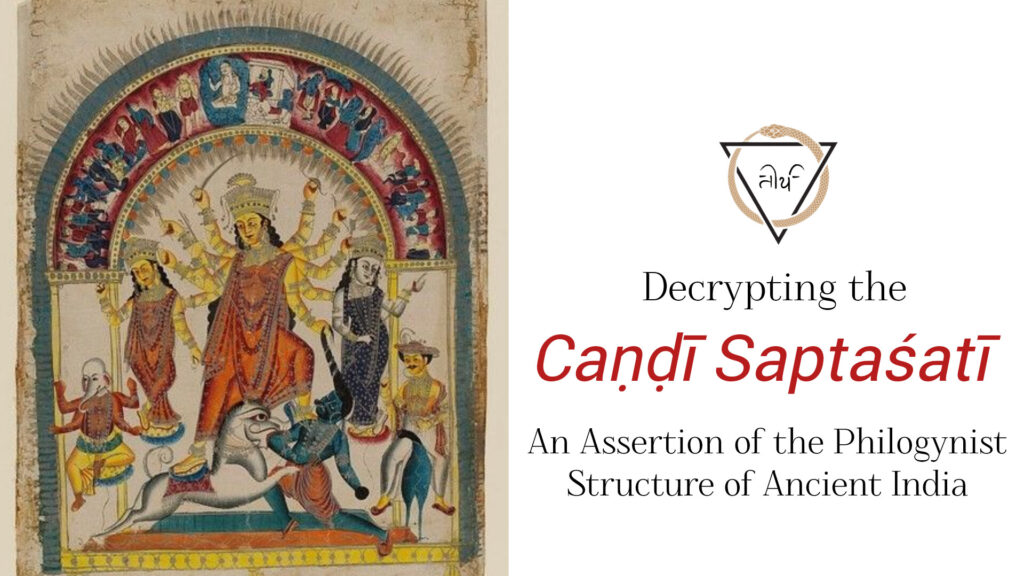
The Caṇḍī Saptaśatī, named after Devī Caṇḍī (an incarnation of goddess Pārvatī), celebrates the divinity with motherly attributes. Despite the fact that the text mostly deals with warfare between the demons and the goddess, the emphasis on her maternal tenderness cannot be discarded at all. “Etymologically, ‘Caṇḍīkā’ means ‘vehement’. She is an affectionate mother but a frantic killer…She is the emblem of dismay and dreadfulness. She remains surrounded by innumerable jackals that inhabit in graveyards and live on carcasses. In brief Caṇḍīkā stands for Death itself…Death, although terrific in appearance, is in reality the single gateway to a realm of beautiful existence” (Brahmachari, 18-22). A mother is extremely tender to her children, but she is also direly vitriolic to the ones who abominate them. This duality of the feminine persona is also embodied by goddess Caṇḍī. It is, de facto, the divine mother “embodies in Herself the multifarious modes of life. All contradictions merge in Her dynamic personality. She is tranquil and turbulent, serene and fierce, soumya and roudra at the same time. She is serene like the azure sky but boisterous like the thunderbolt”, observes Brahmachari (18). The moment we attain this spiritual realization that everything of the cosmos is reared by the divine mother, we begin to worship her thus:
या देवी सर्वभूतेषु मातृरूपेण संस्थिता॥
नमस्तस्यै॥ नमस्तस्यै॥ नमस्तस्यै नमो नमः॥
(Caṇḍī Saptaśatī 5.73)
[O divine goddess! You reside as a mother in every sphere of the cosmos! My obeisance to thee]
She is not merely addressed as a mother to the earthly people, but also to the divine personas. Lord Viṣṇu, considered in the Sanātana scriptures as the apex godhead, worships the divine mother with utmost devotion. Brahmā, the creator of the cosmos, has time and again eulogized her. To quote from Caṇḍī Saptaśatī itself:
चतुर्भुजे चतुर्वक्त्रसंस्तुते परमेश्वरि।
रुपं देहि जयं देहि यशो देहि द्विषो जहि॥
कृष्णेन संस्तुते देवि शश्वद्भक्त्या सदाम्बिके।
रुपं देहि जयं देहि यशो देहि द्विषो जहि॥
(Argalā Stotraṃ 20-21)
[Whom Brahma worships the divine goddess with her four hands and Viṣnu regards as a mother, I bow down to that goddess! May she give me lustre, victory, and prosperity.]
This shows that although the male deities were profusely powerful, they never entertained any hubris in their minds that might denigrate the divine mother. Whereas the four-faced Brahmā sings panegyric in veneration of Śakti, Viṣṇu confers the title of ‘mother’ upon her. The bhaktas of Devī Śakti also craves for rūpaṃ (beautitude), jayaṃ (victory), and yaśa (glory) from her as an infant child seeks for toys from its mother. Establishing this motherly communion between the Devī and her devotee is the maxim of the Caṇḍī Saptaśatī.
In the Ḍāmara Tantra, it is mentioned that there are the aṣtamātṛkā, the eight cosmic mothers, viz. Brāhmī, Māheśvarī, Kaumārī, Vaiṣṇavī, Vārāhī, Nārasiṃhī, Aindrī, and Cāmuṇdā. They are the multifarious incarnations of Ādiśakti, epitomizing the different aspects of motherhood respectively (Jagadishwarananda 235). These divine forms of motherhood preside over the terrestrial and the extraterrestrial both. Thus, the role of a mother has not been limited to the family life, but it has been disseminated throughout the entire universe. Therefore, it is safe to surmise that in ancient India, motherhood was bestowed the pinnacle of reverence. As Lord Viṣṇu states:
सृष्टिकर्ती च प्रकृतिः सर्वेषां जननी परा।
मम तुल्या च मन्मया तेन नारायणी स्मृता।।
(Brahmavaivarta Purāṇa, Gaṇeśa Khaṇḍa, Ch. 7)
[O divine mother! Thou art the creator! Every aspect of nature springs from thee! Thou art the conscientious form of the lord of the universe!]
The diverse modes of a mother’s role in the family and in the society have been personified by the multitudinous actions of the goddess. As Mahanambrata Brahmachari asserts in the Mā Durgār Kāṭhāmo (5): “Although the Divine Mother is Almighty, she is still affectionate. She has been relentlessly blessing us. Whereas She is fierce in the battlefield, she is also tender to Her children. This unflinching tenderness is the reason of her Universal Motherhood”.
The pivotal prospect that the Caṇḍī Saptaśatī establishes is that the entire dialectics of the sublime consciousness is endued by the divine concoction of the Mahāmāyā, another byname of Devī Śakti (Aurobindo). In the course of nature, be it in the sub-atomic particles or in the colossal cosmic spheres, there persists a motherly force which unfathomably regulates the recycle of the triangular order: the creation, the preservation, and the destruction.
सर्वमङ्गलमंङ्गल्ये शिवे सर्वार्थसाधिके।
शरण्ये त्र्यम्बके गौरि नारायणि नमोऽस्तु ते॥
सृष्टिस्थितिविनाशानां शक्तिभूते सनातनि।
गुणाश्रये गुणमये नारायणि नमोऽस्तु ते॥
(Caṇḍī Saptaśatī 11.10-11)
[Thou art the one who bestows auspice to all; the one who accomplishes all tasks; the one who creates, nurtures, and destroys; the one who is eternal and all comprising; I bow down to thee again and again.]
Women and Wisdom
Before the war at Kurukṣetra, Arjuna was advised by Lord Kṛṣṇa to offer his obeisance to goddess Durgā as she is the be-all and end-all of the universal battleground— be it intellectually or physically. In his eulogy, Arjuna depicted her as the embodiment of eloquence, spontaneity, art, enlightenment, wisdom, divinity, and truth. She is also hailed as the epitome of desire, enchantment, illusion, coyness, wealth, murkiness, lustre, the sun and the cosmic mother. To quote his verbal extolment:
स्वाहाकारःस्वधाचैवकलाकाष्ठासरस्वती।
सावित्रीवेदमाताचतथावेदान्तउच्यते।।
…….
त्वंजम्भानीमोहिनीचमायाह्रीःश्रीस्तथैवच।
सन्ध्याप्रभावतीचैवसावित्रीजननीतथा।।
(Mahābhārata 6.23.9-12)
Similarly, the Caṇḍī Saptaśatī bespeaks of the role of women in the field of knowledge, education, art, and erudition. The very nature of the sacred wisdom has, de facto, been personified as a female figure. Without contemplating on that divine feminine, one cannot attain the ‘brahma vidyā’ (the highest aspect of self realization). As it is stated:
पार्वतीपरमाविद्याब्रह्मविद्याप्रदायिनी।
विशेषेणैवजन्तूनांनात्रसन्देहकारणम्।।
(Skanda Purāṇa, Sūta Saṃhitā)
[Pārvatī is the sacred wisdom and she provides this cosmic wisdom to all. There is no doubt about it.]
The Sanātana dharma has never doubted or questioned the merit and efficacy of a woman in the field of intellectuality and has perennially boasted, ‘medhā rūpeṇa saṃsthitā’ (the eternal intellect is presided by the divine feminine). That is why, the Caṇḍī Saptaśatī asserts that the eighteen kinds of vidyā have emanated from the divine feminine. They are: the four Vedas (viz. the Ṛgveda, the Sāmaveda, the Yajurveda, and the Arthavaveda); the six Vedāngas (viz. ‘sikṣā’ meaning ‘learning’, ‘kalpa’ meaning ‘imagination’, ‘vyākaraṇa’ meaning ‘grammar’, ‘nirukta’ meaning ‘vocabulary’, ‘chanda’ meaning ‘rhythm’, and ‘jyotiṣa’ meaning ‘astronomy’, the Dharmaśāstra (tenets), the Mimāṃsa (conclusion), the Nyāya (syllogism), the Purāṇa (history), the Ayurveda (medicine), the Dhanurveda (warfare techniques), the Gandharvaveda (dramaturgy), and the Arthaśāstra (economics). Whereas the Western civilization had considered these fields as the predominantly masculine domains, the Sanātana civilization of India had perpetually acknowledged women’s intellectual contribution in them and provided them equal opportunity in those regards.
Perhaps, the best example of this can be found in the Ṛgveda where Āmbhṛṇī, the wise daughter of sage Ambhṛṇa, envisaged the nature of the divine feminine within herself and encapsulated them in a compendium termed ‘Devīsūktaṃ’. It is also worth noting that she was a woman and she is the recorder of eight ślokas in the Ṛgveda, which itself is a validation of the notion that women were given equal respect in the Veda, and in the society as well. By commingling herself with the divine feminine, she proudly reveals her realization thus:
अहं सुवे पितरमस्य मूर्धन्मम
योनिरप्स्वन्तः समुद्रे।
ततो वि तिष्ठे भुवनानु विश्वो-
तामूं द्यां वर्ष्मणोप स्पृशामि॥
(Ṛgveda 10.125.7)
[I brought about the progenitor into the earth; I sprang from the water of the ocean and from there I spread throughout the universe— I touch that space with a flowering body.]
Education in the Vedic Period was accessible to women equally and it can be succinctly discerned by the portrayal of goddess Caṇḍī. In the dhyāna mantra, she has been depicted as holding a rudrākṣa mālā (a special kind of rosary made with the beads of rudrākṣa) and a pustaka (book) which symbolize a woman’s role in education and in sādhanā. Whereas women in the Western countries had to launch active political campaigns to ensure their rights to education even in the twentieth century, Indian spirituality celebrated women in education since time immemorial. As a matter of fact, the goddess has been hailed as the ‘mother’ of the Veda— the same Veda which has been conferred the title of ‘apouruṣeya’ (that which is not created by man). Not just that, she is the ‘Svāhā’ who is invoked after every āhuti mantra in a yajña as described in the Veda. This is, beyond any question, a proof of the fact that women had equal rights of participation in the act. Eventually, she is hailed as the ‘Gāyatrī mantra’ which a Brāhmaṇa must chant every day:
त्वं स्वाहा त्वं स्वधां त्वं हि वषट्कारःस्वरात्मिका॥
सुधा त्वमक्षरे नित्ये त्रिधा मात्रात्मिका स्थिता।
अर्धमात्रास्थिता नित्या यानुच्चार्या विशेषतः॥
त्वमेव संध्या सावित्री त्वं देवि जननी परा।
त्वयैतद्धार्यते विश्वं त्वयैतत्सृज्यते जगत्॥
(Caṇḍī Saptaśatī 1.73-75)
[O goddess! Thou art the svāha, thou art the svadhā, thou art the vaṣatkāraḥ! The voices are also from you. You are the life-giving sudhā. In the eternal cosmic sound called praṇava, thou art the akāra, ukāra, and makāra. Thou art the vindu which is the eternal quantity and therefore cannot be measured just like thee. Thou art the sandhyā, sāvitrī, and the mother of the cosmos and thou embellish everything.]
Delving deeper in the Devī Bhāgavata (1.2.20), the Ādiśakti has been categorized into three kinds based on the three guṇas mentioned in the Veda. Sarasvatī is the manifestation of her sāttvika śakti (creative power), Lakṣmī as her rājasika śakti (preservative power) and Kālī as tāmasika śakti (destructive power). Whereas she is the reason behind the mokṣa for the wise, she is also the reason for the miseries of the ignorant. As it is clearly stated that Mahāmāyā is the ‘avidyā’, but at the same time, she is also the ‘brahma vidyā sanātanī’:
सैषाप्रसन्नावरदानृणांभवतिमुक्तये।
साविद्यापरमामुक्तेर्हेतुभूतासनातनी।।
संसारबन्धहेतुश्चसैवसर्वेश्वरेश्वरी।।
(Caṇḍī Saptaśatī 1.57-58)
[Thou have a pleasant face and so is thy wisdom. Thou hold the cosmic wisdom in thee and that is why thou art eternal. Thou art the reason of ignorance and the enlightenment both.]
Therefore, one who seeks knowledge has to surrender oneself utterly to her congenial rapport in order to gain her blessings. Once pleased, she enlightens us with the eternal truth. That is why, the worshipper asks for knowledge and glory to the motherly spirit:
विद्यावन्तं यशस्वन्तं लक्ष्मीवन्तं जनं कुरु।
रुपं देहि जयं देहि यशो देहि द्विषो जहि॥
(Argalā Stotraṃ 17)
[O goddess! Give me knowledge, glory, and spiritual wealth; provide me with lustre, victory, fame, and prosperity.]
Śakti is Feminine, Feminine is Śakti
In tantra śāstra, the goddess is the supreme spirit and almighty. However, one who endeavours to obtain her powers only for the sake of personal gratification is bound to doom. “According to the Tantra Śāstra, the Mahāśakti is a fully conscious Spirit and hence is an object of worship and veneration. Instead of controlling, Tantra endeavours to establish communion with the Śakti. Śakti for a Tantrik is not only conscious but benignantly gracious also. The kindly disposition and heartfelt affection of the Śakti is deeply personal and unfathomably profound”, says Brahmacari (17). She is the emblem of the cumulative force of all the deities:
अतुलं तत्र तत्तेजः सर्वदेवशरीरजम्।
एकस्थं तदभून्नारी व्याप्तलोकत्रयं त्विषा॥
(Caṇḍī Saptaśatī 2.13)
[Thy aura is immense, endless, and unmatched. It glistens all over all the three spheres of the cosmos.]
The Mahāmāyā is nonpareil in might and unparalleled in summum bonum. She is the a priori and the a posteriori both and her whim is the reason behind all the phenomena in the microcosm and the macrocosm of the universe. It is by her sheer power, the creation and the destruction both occur. She is also the cause behind the attachment which results in ‘bandhana’ and the nonattachment which eventuates in ‘mukti’ (Jagadishwarananda 48). That is why, Vyāsa has illumined king Janmejaya thus:
यथा नटो रङ्गगतो नानारूपो भवत्यसौ।
एकरूपो स्वभावोऽपि लोकरञ्जनहेतवे।।
तथैषा देवकार्यार्थमरूपालि स्वलीलया।
करोति बहुरुपाणि निर्गुणा सगुणानि च।।
(Devī Bhāgavata 5.8.58-59)
[Thou art formless, and yet thou take many forms to nurture the functions of the universe. Although thou have nothing to do, thou art the one who does everything.]
Although she is nirguṇa (inactive) and nirākāra (inanimate), for the purpose of līlā (cosmic dalliance) she takes up actions of all three kinds— good, moderate, and evil. She has been defined multitudinous times by different groups of esoteric philosophers. The Sāṃkhya Darśana ascribes this divinely feminine force as the ‘prakṛti’. The scholars of Vedānta have termed it as ‘avidyā’. The Vaiyākaraṇīka group (id est grammarians) have given it the nomenclature of ‘śabdaśakti’. The Mimāṃsā philosophers have called it the ‘karma upādāna’. The ‘vastuttvāvasitisiddhibhedā’ is what the Nyāya Darśana (Indian syllogism) has termed it. Whereas the Śaivas (or Shaivites) have called it the ‘śakti’, the Vaiṣṇavas have named it ‘Viṣṇumāyā’. The Śāktas have termed it ‘mahāmāyā’ and the ‘devī’ is the term given to it by the school of Purāṇas (Jagadishwarananada 127). In the Kālikā Purāṇa (6.59), she is has been called as the ‘yoga nidrā’ (the cosmic slumber):
या निम्नान्तःस्थलाधःस्था जगदण्डकपालतः।
विभज्य पुरुषं याति योगनिद्रेति सोच्यते।।
[Thou art the eternal and cosmic slumber which governs the function of the cosmos.]
Expatiating this in the Jagajjananī Kālīmātār Tattva (27), Mahanambrata Brahmachari rightly asserts, “Who then exist in that nocturnal abyss of complete silence? She is the Yoganidrā, the great motherly energy that upholds the Cosmic Sleep”. While creation, she acts as the energy of Brahmā; as the energy of Viṣṇu while preservation; and as that of Śiva while destruction (Caṇḍī Saptaśatī 12.39). She is also the mahārātri (the cosmic night). Just like the human activities are put into rest at night, the cosmic activities are put alike by the mahāratrī, implying utter nihilism. She is the ‘brahmamāyātmikā ādiśakti’ — the eternal, invincible, and the almighty. As she is the ultimatum of the divine energy, access to her is locked by her divine consort, Śiva, so that only the congenial people can attain her grace by righteous penance. This is why, the recitation of the Caṇḍī Saptaśatī incepts with the ‘Kīlaka Stava’, which implies the unlatching of the storehouse of energy by an august eulogy.
Women in Warfare
In the Caṇḍī Saptaśatī, goddesses take part in warfare and this very instance metaphorically indicates that female warriors can also serve in the battles shoulders to shoulders with their male counterparts. In the Devī Kavaca (9-13), we find a gang of female warriors who indulge in a menacing fisticuff with the demons. Devī Cāmuṇḍā, who wears the garland made of decapitated heads, dismays the demons in the war. The goddess Vārāhī rides a raging bull and conquers the enemies. Aindrī, wife of Indra, rides her husband’s elephant named Airāvata and demolishes the army of the demons. Vaiṣṇavī (or Lakṣmī) rides the divine bird Garuḍa and conquers the devils. Apart from that, many other female warriors such as Nārasiṃhī, Māheśvarī, Kaumārī, Brāhmī and others vanquish the enemies in the battleground.
Perhaps, the best example of a woman’s tactfulness in the war occurs when goddess Durgā tricked a demon called Śumbha into the battlefield. The demon had attained a boon that no man (or male) creature would ever be able to defeat him in any combat. As a result, his insolence became relentless and he audaciously ousted the deities from the heaven. So, the devatās prayed to goddess Durgā and, pleased, she promised them justice. The goddess then hatched a plot which is now termed as ‘honey trap’ in modern warfare. The lustrous goddess started dancing very seductively which lured the attention of the demons. When Śumbha heard about her beauty, he became lovesick. He sent his accomplice to the goddess and solemnly offered a proposal of marriage. The goddess told them that she would only yield to the proposal if the demon comes and defeats her in a brawl as it was a custom in her family that she could only marry the man who would accomplish the aforementioned task. Laughing at the suggestion, the demon haughtily told her that how a woman who is deemed to be weak could even think of battling a masculine demon such as him whom the strongest of men could not defeat. However, when the goddess remained adamant in her words, the demon decided to fight her which resulted in his doom. Having so many instances of female warriors who emerged victorious, it is not hard to perceive that a woman in the Sanātana culture is considered as strong a fighter as her masculine counterpart, if not stronger. The Caṇḍī Saptaśatī exemplifies this in all essence.
Not just in warfare, but women also could practise extremely ascetic sādhanā which is generally considered to be the trait of masculine capability. When goddess Pārvatī decided to do penance to secure the dignity of Śiva’s wife for herself, she slowly relinquished all her diets. After many years of living on mere fruits and vegetables, she started to sustain only upon the fallen leaves of the trees. When she even left that, she was given the name ‘Aparṇā’ (one who does not even consume a leaf). Witnessing the devotion of the highest kind, Śiva accepted her as his spouse. Thus, it is observable that women have been portrayed as valorous, courageous, and indomitable rather than meek and feeble as portrayed by the Western countries for a long time.
From Devī as a Daughter to Daughter as a Devī
It is an inexplicable remorse that India has witnessed innumerable cases of female foeticides and infanticides of girl children. It is, perhaps, mainly due to the fact that the philogynist culture of India was systematically destroyed for over a period of a thousand years by the ‘zenana culture’ of the Islamic rulers and then by the ‘Victorian morality’ of the British Raj (Ganguly 1). However, there is a grave misconception which has been persistent for a long time that the Sanātana culture is detrimental to women.The people who practise Sanātana dharma have perpetually celebrated daughterhood and value the girl children no less than the boys. The Caṇḍī Saptaśatī asserts that Śaila, the lord of mountains, worshipped the goddess Ādiśakti and craved her to take an incarnation as his daughter— a wish which the goddess fulfilled. As a result, she was given the name ‘Śailaputrī’ (daughter of Śaila). Not just that, the goddess also took another incarnation when the great sage, Katyāyana, requested her that he needed a daughter who would help him in the yajña (Jagadishwarananda, 22). This very instance encrypts an implication of the tripartite aspects: a) people valued their daughters as much as their sons, and also prayed for girl children; b) girls were given proper education as per the Veda; c) girls also performed and accompanied in the yajñas in the Vedic Period. The Devī Kavaca (43) explicitly invokes the goddess Kaumārī to bless the girl children in the family.
The ‘Kumārī Pūjā’ is a foremost example of the fact that the Sanātana culture has given the highest dignity to a girl child. The occasion which takes place every year on the ninth day of Durgā Pūjā (or Navarātri) celebrates girl children and worships them as the embodiment of the goddess. As Swami Nigamananda wisely records in the Ādarśa Gārhastha Jīvan (198), “The virgin girls are the embodiment of the Divine Mother and they deserve to be worshipped. Young girls who are living with virginity are like the Devī and worshipping them is very necessary if an ideal society is to be constructed. An infant girl child is none but the Divine Mother herself. The Gāyatrī mantra that we chant has been compared with a virgin girl child. The great sages have contemplated the Divine Energy in the form of a holy virgin”.
Goddess as a Wife
In the Sanātana dharma, man and woman are considered equal and reciprocal in completing each other. Women are considered to be an epitome of Śakti (the divine femininity) and men are considered as that of Śiva. Mahanambrata Brahmachari has penetrated the concept very subtly when he states, “For the purpose of Creation, the Absolute Being divides Itself into two—Śiva and Śakti. They are essentially identical, but functionally different. She is the patta mahiṣī (queen consort) of Śiva” (Jagajjananī Kālimātar Tattva 18). Similarly, in the mundane world, humanity is divided into two primary genders (if we are allowed to omit the third gender for the sake of the analogy). Therefore, although both the genders have been given different attributes and purposes for sustaining the humankind, they both have been given equal respect and rights in all form. The role of a wife in the family, as well as in the spiritual path, has been given uttermost importance. That is why, the Brāhmaṇa prays to goddess Durgā to:
पत्नीं मनोरमां देहि मनोवृत्तानुसारिणीम्।
तारिणीं दुर्गसंसारसागरस्य कुलोद्भवाम्॥
(Argalā Stotraṃ 25)
[O goddess, provide me a wife who would be winsome to my mind and sail me through the ocean of the life in thick and thin, leading me to the mokṣa.]
Whereas in the Western countries, the women were (and, in many cases, even today are) addressed by their husband’s names or surnames, in the Vedic Period men were addressed by their wives’ names and vice versa. The most propelling instance of this can be traced in the Caṇḍī Saptaśatī as well. Time and again, we encounter that male deities are invoked by their wives’ names. For instance, ‘Indrānīpati’, meaning ‘husband of Indrānī’, is used for Indra and ‘Himācalasūtānātha’, meaning ‘groom of the daughter of Himācala’ for Śiva (Argalā Stotraṃ 22-23). Ipso facto, it can be surmised that in the Sanātana culture, a husband does not consider his wif as subordinate, but per contra as the alter ego of his own selves. In the Caṇḍī Saptaśatī (8.28), we observe goddess Durgā appointing her husband, Lord Śiva, as an emissary to deliver her message to the demons and he readily complies without any hesitation or feeling of abashment. Hence, it is safe to draw an idea that in the Vedic Period, men and women enjoyed an amiable conjugal harmony in all terms.
Celebration of the Feminine
Whereas it often seems that the Caṇḍī Saptaśatī has almost portrayed the goddess as the omnipotent force in toto, it is not so. She has also been radiantly poignant in her womanly feelings. For example, when Śiva once whimsically takes a jibe at Pārvatī by addressing her as ‘Kālī’ (dark lady), she becomes very sulky at her husband. As a result, she temporarily abandons her husband and indulges in a certain yoga sādhanā by which she transforms her complexion into a fair one. Unless one is too judgemental about the complexion, one can easily trace a very beautiful conjugal feeling that exists in the Sanātana culture.
Just like an ordinary woman is fond of adorning herself with ornaments, apparels, and jewelleries, so is goddess Pārvatī in almost all her incarnations. Her concerns about her beauty and her fondness towards the paraphernalia have been vividly delineated time and again. Her round and curvaceous breasts, her graceful face, her callipygous bahookie— all have been poetically painted in the Caṇḍī Saptaśatī and, thus, the celebration of the feminine aspects has reached a zenith.
Conclusion
The goddess in the Caṇḍī Saptaśatī is no less a woman than we encounter in our everyday life. She, in all her deeds, exemplifies the diversity of a woman’s life. She encrypts in herself the winsome lesson of spiritual matriarchy where a woman can be a loving wife who passionately sulks at her husband, and yet she can also be a robust warrior who slays the enemy in the battlefield. She is sometimes whimsical, sometimes profoundly contemplative. She is the mother of one man, but she is also the daughter of another. Her path is unpremeditated, yet her path is the obvious inevitable. Whatever she does, she does it like a goddess and the way of a goddess is— perplexingly oxymoronic and paradoxical— just like a woman!
Works Cited
Aurobindo, Sri. The Mother, ch. II. Sri Aurobindo Ashram, 2005.
Brahmachari, Mahanambrata. Saptaśatī Samanvita Caṇḍī Cintā. Sri Mahanmbrata Cultural and Welfare Trust, 1999.
———. Jagajjananī Kālīmātār Tattva. Sri Mahanmbrata Cultural and Welfare Trust, 2007.
———. Mā Durgār Kāṭhāmo. Sri Mahanmbrata Cultural and Welfare Trust, 2007.
Chattopadhyay, Nipenkrishna, translator. Śrī Śrī Caṇdī. Dev Sahitya Kuthir, 2017.
Chaturvedi, Jwalaprasad, translator. Kalikā Purāṇa. Randhir Publications, 2007.
Ganguly, Tirthendu. “Celebrating Female Desire in the Medieval Era: an Exegesis of the Erotic Verses from Jayadeva’s Gītagovinda”. Rupkatha Journal on Interdisciplinary Studies in Humanities, vol. 12, no. 4, 2020, p. 1.
Jagadishwarananda, Swami, translator. Śrī Śrī Caṇdī. Udbodhan Karyalay (Ramkrishna Math), 2019.
Jha, Tarinish, and Baburam Upadhyay, translators. Brahmavaivarta Purāṇa. By Vyāsa, Hindi Sahitya Sammelan Prayag, 2008.
Khandelwal, S. N., translator. Skanda Purāṇa. By Vyāsa, Chaukhambha Publication, 1999.
Madhavacarya. Sūta Saṃhitā. Bharatiya Kala Prakashan, 2006.
Nigamananda, Swami. Yogīguru. Assam Bangiya Saraswat Math, 2005.
———. Ādarśa Gārhastha Jivan.Assam Bangiya Saraswat Math, 1999.
‘Matriarchy’. Oxford Advanced Leaner’s Dictionary (OALD), ed. 10th, Oxford University Press (2020).
Rampton, Martha. “The Three Waves of Feminism”. Pacific Magazine, Fall, 2008. Pacific University.
Ray, Krishna Kumar, translator. Ḍāmara Tantra. Prachya Prakashan, 2008.
Sharma, Ganga Sahay, translator. Ṛgveda. Vishv Books, 2014.
Tripathi, Yogeshwar, translator. Mārkaṇdeya Purāṇa. By Vyāsa, Devvani Publications, 2002.
Vyāsa. Mahābhārata, vol. 1, ch. 6. Gita Press, 2015.
———. Devī Bhāgavata Purāṇa. Gita Press, 2016.