
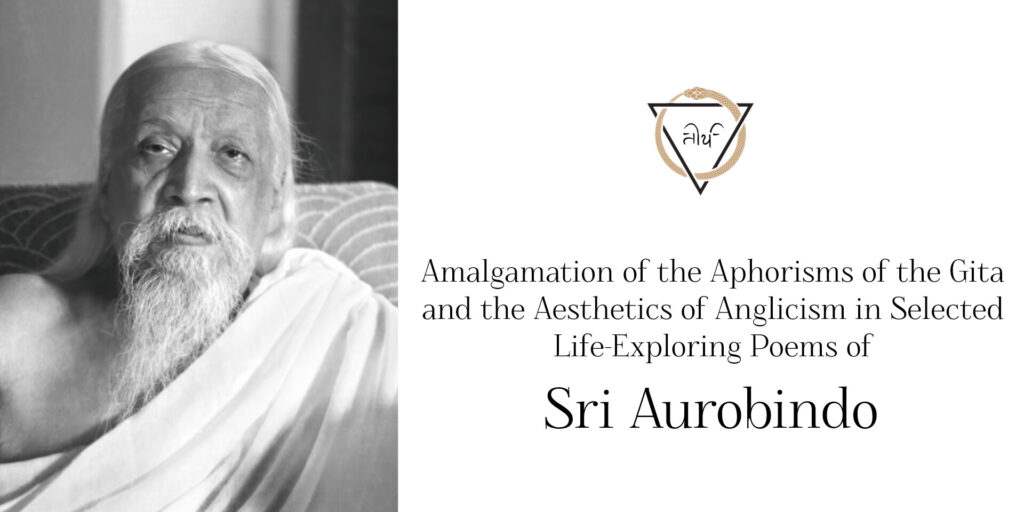
“Soul, exceed life’s boundariness;
Spirit, surpass the universe.”
— Sri Aurobindo
Introduction
During the Golden Era of the Roman Empire, it was ruled by the triumvirate of Augustus Caesar, Mark Antony, and Marcus Lepidus. It would not be a hyperbole if we state that the Golden Era of Bengali literature was also dominated by the literary triumvirate of Rabindranath Tagore, Swami Vivekananda, and Sri Aurobindo. All of the trio have made ebullient contribution to erect the edifice of spiritual poetry, and it is beyond any doubt that the spiritual lessons of the Gita became the bricks of its construction. Whereas Tagore and Vivekanada chiefly wrote in Bengali, Sri Aurobindo penned most of his creations in English due to his Anglican upbringing since childhood. Excelling in the studies of classical Greek and Latin literature at the King’s College of Cambridge University, Aurobindo began writing philosophical poems and earned the friendship of Oscar Browning, son of the great British poet Robert Browning. However, it was not until he landed in India at the age of twenty when he first became aware of the vast philosophical poetry of ancient India. After some initial tuition of Sanskrit by prominent pundits, he unlocked the spiritual treasures of India. It was at this time he decided that he would model his life and his poetry according to the lessons of the Gita, which eventually culminated during his Pondicherry days at the Sri Aurobindo Ashram.
Reflections of Gita in the Life-exploring Poetry of Sri Aurobindo
Sri Aurobindo’s poems can be chronologically categorised in three phases, according to the shifts in thoughts and themes. The first phase contains his poems which he wrote during his university days. They primarily deal with the Western philosophy and aesthetics and do not reflect Indian sensibility, as earlier told. It is the second phase of his poetry where the reflections of Gita in his life and his poetry can be observed clearly. In his poem, ‘Renewal’, he describes his feelings thus:
“When the heart tires and the throb stills recalling
Things that were once and again can be never,
When the bow falls and the drawn string is broken,
Hands that were clasped, yet for ever are parted…”
These lines clearly resemble to the opening chapter of the Gita. When Arjuna observed that he had to fight against his own kinsmen in the great war of Mahabharata, his body trembled and his bow (the Gandiva) fell as he thought of the aftermath. The very image presented by Aurobindo in this poem alludes to the Gita (Chapter I, Verse 30).
In ‘Soul in the Ignorance’, Sri Aurobindo rebukes his own self and commands his soul to awake from the slumber of ignorance. The first stanza of the poem sternly resemble how Lord Krishna rebuked Arjuna for his ignorance in the Gita (Chapter II, Verse 11). Just like Lord Krisna consoles Arjuna after the mild snub and enlightens him that one should not mourn for someone’s death as the soul is immortal, the second stanza of the poem also follow alike:
“Feel thyself God-born, know thyself deathless.
Timeless return to thy immortal existence.”
Divided into two sections, the poem ‘Ascent’ also loiters around the same theme. In the second stanza of the first section, the poet describes the qualities of the ‘ātmā’ (the soul) in the same way the Gita (Chapter II, Verse 20) delineates. The lines are as followed:
“Spirit, pass out of thyself;
Soul, escape from the clutch of Nature.
All thou hast seen cast away from thee, O Witness.
Turn to the Alone and the
Absolute, turn to the Eternal:
Be only eternity, peace, and silence,
World-transcending nameless Oneness,
Spirit immortal.”
Whereas in the first section of the poem, the poet urges us to move “into the Silence”, in the latter section, he takes a U-turn, asking us to move “out from the Silence”. However, he assures silently that whether we look into life or look out of it, life is “God-possessing”. The phrases (such as, “All-Beautiful”, “Joy unimaginable”, “Ecstasy illimitable”, “Knowledge omnipotent”, “Might omniscient”, “Light without darkness”, and “Truth that is dateless” etc.) that Sri Aurobindo uses to explicate the grandeur of the almighty are very reminiscent of the Gita (Chapter XI, Verses 37-40).
Sri Aurobindo’s Descent talks about the all-pervading godhead (or ‘Brahman’ to be more specific). Just as the Gita describes that the Brahman is omniscient, omnipotent, and omnipresent, Sri Aurobindo’s poem also celebrates the eternal philosophy. That everything is consumed by the Brahman, and Brahman is the one that consumes everything is the quintessence that the Gita preaches. Aurobindo also enlightens the reader by elaborating the qualities of the supreme divine being:
“All the world is changed to a single oneness;
Souls undying, infinite forces, meeting,
Join in God-dance weaving a seamless Nature,
Rhythm of the Deathless.
Mind and heart and body, one harp of being,
Cry that anthem, finding the notes eternal, —
Light and might and bliss and immortal wisdom
Clasping for ever.”
To demonstrate the lines, Aurobindo’s words in his famous Essays on the Gita can be quoted: “The thought of the Gita is not pure Monism although it sees in one unchanging, pure, eternal Self, the foundation of all cosmic existence, nor Mayavada although it speaks of the Maya of the three modes of Prakriti omnipresent in the created world; nor is it qualified Monism although it places in the One, his eternal supreme Prakriti manifested in the form of the Jiva and lays most stress on dwelling in God rather than dissolution as the supreme state of spiritual consciousness; nor is it Sankhya although it explains the created world by the double principle of Purusha and Prakriti; nor is it Vaiṣnava Theism although it presents to us Krishna, who is the Avatar of Vishnu according to the Puranas, as the supreme Deity and allows no essential difference nor any actual superiority of the status of the indefinable Brahmann over that of this Lord of beings who is the Master of the universe and the friend of all creatures. Like the earlier spiritual synthesis of the Upanishads this later synthesis at once spiritual and intellectual avoids naturally every such rigid determination as would injure its universal comprehensiveness. Its aim is precisely the opposite to that of the polemist commentators who found this Scripture established as one of the three highest Vedantic authorities and attempted to turn it into a weapon of offence and defence against other schools and systems. The Gita is not a weapon for dialectical warfare, it is a gate opening on the whole world of spiritual truth and experience and the view it gives us embraces all the provinces of that supreme region. It maps out, but it does not cut up or build walls or hedges to confine our vision”.
In Life, Sri Aurobindo contemplates upon eternity in a very similar way which is found in the Gita. Aurobindo pens:
“Mystic Miracle, daughter of Delight,
Life, thou ecstasy,
Let the radius of thy flight
Be eternity.”
Just like Sri Krishna indoctrinates the eternal truth that though our body deteriorates with time, our soul remains afresh, Sri Aurobindo also borrows the same thought. In the Gita (Chapter II, Verse 23), it is said: “The atman (soul) cannot be pierced by weapons, nor burnt by fire; neither can it be moistened by water, nor dried by air”. Sri Aurobindo’s final stanza of the poem Life echoes the same:
“Even in rags I am a god;
Fallen, I am divine;
High I triumph when down-trod
Long I live when slain.”
The same theme is reverberated in Sri Aurobindo’s Ocean Oneness. However, here the importance shifts towards silence and trance. The wideness of the circumference of the almighty is ineffable and all-consuming. As in the Gita, it is explored that even innumerable galaxies to the supreme being are like a drop of water to the ocean. The calm, indifferent, and stolid of form of eternal existence has been meditated upon and it seems as if Sri Aurobindo’s poem is a just replica of that “voiceless heaven”. As he airs:
“Identified with silence and boundlessness
My spirit widens clasping the universe
Till all that seemed becomes the Real,
One in a mighty and single vastness.”
Sri Aurobindo goes on calling upon the the supreme being or Brahman who is “nameless and bodiless”, “conscious and lonely”, “deathless and infinite”, and yet he is “sole in a still eternal rapture”. Therefore, what Sri Aurobindo emphasizes is that though the Brahman is indifferent and passive, there is also an active and influential force within him which binds the threads of the universe.
Nirvana, another lyric poem by Aurobindo, uses the background of this sublime consciousness. In this poem, he contemplates upon the craving of a soul for deliverance. In the Gita (Chapter V, Verse 25-27), Lord Krishna says: “The one who is content in oneself, the one who is delighted in himself, the one who contemplates upon his own true self, such a practising soul mingles with the ultimate and almighty being and achieves the deliverance. The one whose all mundane obstacles are severed by the spiritual knowledge, the one whose mind is freed from impurity, the one whose sole interest is the wellbeing of mankind, and the one who is calm and inveterate in all situations, that enlightened being observes the divine aura of the almighty. The one who is disciplined and free from lust and wrath, feels the entire environment consumed by the omnipresent Brahman”. After this, lord Krishna teaches Arjuna the fundamental tenet of spiritual meditation by delving deep into one’s own spirit and discovering his true identity by activating the dormant self. In the same way, Aurobindo’s Nirvana contemplates upon the spiritual discovery:
“Only the illimitable Permanent
Is here. A Peace stupendous. Featureless, still.
Replaces all,— what once was I, in It
A silent unnamed emptiness content
Either to fade in the Unknowable
Or thrill with the luminous seas of the Infinite.”
Like the above most other short poems and lyrics composed by Sri Aurobindo encircles around the aphorisms of the Gita. Poems such as Because Thou Art, Bliss of Identity, Infinitesimal Infinite, Iron Dictators, The Yogi on the Whirlpool, The Kingdom Within, and Transformation et cetera also draw heavily from the teachings of the Gita.
Conclusion
The spiritual poetry composed by Sri Aurobindo can undoubtedly be applauded as a manifestation of the spiritual lessons of the Gita which are not merely scripted and jotted down on the paper, but personally experienced by the poet. But above all, these poems show the odyssey of a man in the path of spirituality— the agony and the rapture, the sordidness and the ecstasy, the hustle and the sedateness— all engulfed by the adamant will to step from the known to the unknown.
Works Cited
Svāmī, A. C. Bhaktivedānta. Bhagavad-Gita As It Is. Mayapur: The Bhaktivedanta Book Trust, 2015. Print.
Aurobindo, Sri. Essays on the Gita. Pondicherry: Sri Aurobindo Ashram Publication Department, 2001. Print.
Brahmanchari, Mahanambrata. Geeta Dhyan. Kolkata: Shri Mahanambrata Cultural and Welfare Trust, 2011. Print.
Ghosh, Jagadish Chandra. Sri Gita. Kolkata: Presidency Library, 2014. Print.
Ghosh, Jagadish Chandra. Sri Krishna O Bhagavad Dharma. Kolkata: Presidency Library, 2014. Print.
Ghosh, Jagadish Chandra. The Soul of India Speaks. Kolkata: Presidency Library, 2013. Print.
Aurobindo, Sri. Collcted Poems and Plays (Vol. II). Pondicherry: Sri Aurobindo Ashram Publication Department, 2001. Print.
Aurobindo, Sri. The Life Divine. Pondicherry: Sri Aurobindo Ashram Publication Department, 2001. Print.
Aurobindo, Sri. The Future Poetry. Pondicherry: Sri Aurobindo Ashram Publication Department, 2001. Print.
Aurobindo, Sri. The Integral Yoga. Pondicherry: Sri Aurobindo Ashram Publication Department, 2001. Print.
Aurobindo, Sri. Karmayogin. Pondicherry: Sri Aurobindo Ashram Publication Department, 2001. Print.
Aurobindo, Sri. The Synthesis of Yoga. Pondicherry: Sri Aurobindo Ashram Publication Department, 2001. Print.